High-Performance Industrial Protection Components
Explore our top-tier VDE & TÜV verified DC/AC Surge Protection Devices, Solar PV Fuses, and Circuit Breakers engineered for rugged industrial environments.

Evaluating Top 10 Global Industrial Surge Protector Suppliers: Engineering Selection Criteria
In high-stakes industrial electrical distribution, photovoltaic utility arrays, and Battery Energy Storage Systems (BESS), transient overvoltages triggered by indirect lightning strikes, grid switching events, and electrostatic discharges present existential risks to expensive infrastructure. Choosing a qualified industrial surge protector supplier requires moving beyond rudimentary pricing to evaluate deep engineering compliance, manufacturing precision, thermal disconnector integrity, and third-party verification credentials.
Global electrical engineers evaluate Tier-1 surge protective device (SPD) manufacturers against strict operational metrics established under international electrotechnical standards, notably IEC 61643-11 (for low-voltage AC power systems) and IEC 61643-31 (for photovoltaic installations). Leading global brands such as DEHN, Phoenix Contact, ABB, Schneider Electric, Eaton, Citel, Raycap, Siemens, Tripp Lite, and specialized high-capacity OEM manufacturers like Luck (Zhejiang) New Energy Co., Ltd. represent the pinnacle of transient voltage surge suppression (TVSS) technology.
Technical Standard Benchmark: IEC 61643-11 vs. IEC 61643-31 Categorization
Industrial procurement teams must carefully verify the protection class and electrical parameters of surge protective devices across varying operational zones (LPZ 0 through LPZ 3). Below is an authoritative technical breakdown of standard surge protection classifications used by top exporters worldwide:
| Protection Test Class | Standard Reference | Waveform Standard | Core Application Zone | Key Rating Criteria |
|---|---|---|---|---|
| Type 1 (Class I) | IEC 61643-11 / UL 1449 | 10/350 μs Direct Impulse | Main Distribution Boards / LPZ 0A to 1 | Impulse Current ($I_{imp}$) ≥ 12.5kA / 25kA per pole |
| Type 1+2 (Class I+II) | IEC 61643-11 & 61643-31 | 10/350 μs & 8/20 μs Hybrid | Solar PV Combiner Boxes & Inverters | $I_{imp}$ ≥ 7kA to 12.5kA, $I_n$ ≥ 20kA |
| Type 2 (Class II) | IEC 61643-11 / IEC 61643-31 | 8/20 μs Nominal Surge | Sub-distribution Boards / LPZ 1 to 2 | Nominal Discharge ($I_n$) ≥ 20kA, $I_{max}$ ≥ 40kA |
| Type 3 (Class III) | IEC 61643-11 | 1.2/50 μs - 8/20 μs Combination | Sensitive Terminal Equipment / LPZ 2 to 3 | Open Circuit Voltage ($U_{oc}$) ≤ 10kV, Voltage $U_p$ ≤ 1.0kV |
Critical Failure Modes in Industrial Environments & Prevention
Unlike commercial surge strips, industrial SPDs must withstand extreme electrical stresses without triggering structural catastrophic failures or thermal runaway. When Metal Oxide Varistors (MOVs) degrade due to repetitive lightning strikes or continuous Temporary Overvoltage (TOV) conditions, their internal resistance drops, resulting in leakage current elevation and thermal heat accumulation.
Top suppliers prevent fire hazards by integrating internal Thermal Disconnect Mechanisms (TDMs) coupled with arc quenching technology. When internal temperatures exceed 120°C–150°C, low-temperature solder links melt, mechanically isolating the degraded MOV module from the power rail while triggering a visual red window indicator and activating remote auxiliary monitoring contacts ($S$).
Future Product Trends in Industrial & Photovoltaic Surge Protection
As global power architecture transitions to higher DC voltages and smart grid topologies, industrial surge protective devices are undergoing significant technological evolutionary shifts.
1500V DC High Voltage Transition
Driven by modern utility-scale solar farms and megawatt BESS containers, system voltages have migrated from 1000V DC to 1500V DC. Next-generation SPDs utilize custom Y-configuration MOV arrays capable of continuous operating voltages ($U_{cpv}$) reaching 1500V DC with ultra-low residual protection levels ($U_p < 4.8\text{ kV}$).
Thermally Protected MOV (TPMOV)
To completely eliminate thermal runaway risks under short-circuit conditions, high-end suppliers incorporate encapsulated Thermally Protected Varistors (TPMOV) with arc-extinguishing chambers, achieving short-circuit current withstand ratings ($I_{scpv}$) up to 10kA to 100kA without requiring secondary backup fuses.
IoT Smart Health Telemetry
Industrial Automation 4.0 demands real-time status intelligence. Modern SPDs feature integrated RS485 Modbus communications, IoT wireless telemetry, and impulse counters that record impulse amplitude, exact surge timestamps, and remaining varistor health life directly to SCADA interfaces.
Global Procurement Trends: Navigating Supply Chains & OEM Customization
Procurement directors and B2B buyers face evolving regulatory and economic landscapes when sourcing surge protection hardware. Achieving maximum supply chain resilience requires balancing technical performance, lead times, certification compliance, and total cost of ownership (TCO).
key trends defining global B2B procurement strategies in 2025 and beyond include:
- Direct-from-Factory OEM/ODM Partnerships: EPC contractors and regional brands are increasingly bypassing traditional multi-tier trade distributors to source directly from verified specialized manufacturing hubs such as Yueqing, Wenzhou. Customization capabilities—such as custom clamping voltage tuning, private labeling, color-coded housings, and pre-wired combiner box integration—provide significant competitive differentiation.
- Multi-Standard Verification (VDE, TÜV, UL, CE): Cross-border compliance is critical. Importers prioritize suppliers whose manufacturing lines hold verified third-party audit credentials (such as TÜV Rheinland onsite verified reports) and whose core product series carry dual VDE (European standard) and UL 1449 / UL 248-19 (North American standard) certifications to streamline global export processes.
- Modular Plug and Play Design Requirements: Operational downtime in data centers and utility PV plants carries heavy financial penalties. Modern procurement specs mandate DIN-rail mounted pluggable cartridge systems with automatic remote signaling, allowing maintenance teams to swap spent MOV modules in seconds without disconnecting main electrical busbars.
Why Luck (Zhejiang) New Energy is the Premier Manufacturing Partner
Positioned at the core of Wenzhou's Yueqing Low-Voltage Electrical Industrial Cluster, Luck (Zhejiang) New Energy Co., Ltd. combines 12+ years of specialized engineering expertise with rigorous quality assurance.
VDE & TÜV Certified Quality
Our products undergo stringent testing protocol compliance. The MYN40 and MYH7 surge protection lines hold authoritative VDE and TÜV certificates, while our 10x38mm DC fuse series fully conforms to IEC 60269-6 and UL 248-19 standards.
In-House Impulse Testing Lab
Our factory is equipped with 9 precision testing instruments, including high-impulse current generators capable of simulating 8/20μs surge currents and thermal stability testing benches. Every production lot undergoes 100% finished product inspection.
7+ Years OEM / ODM Authority
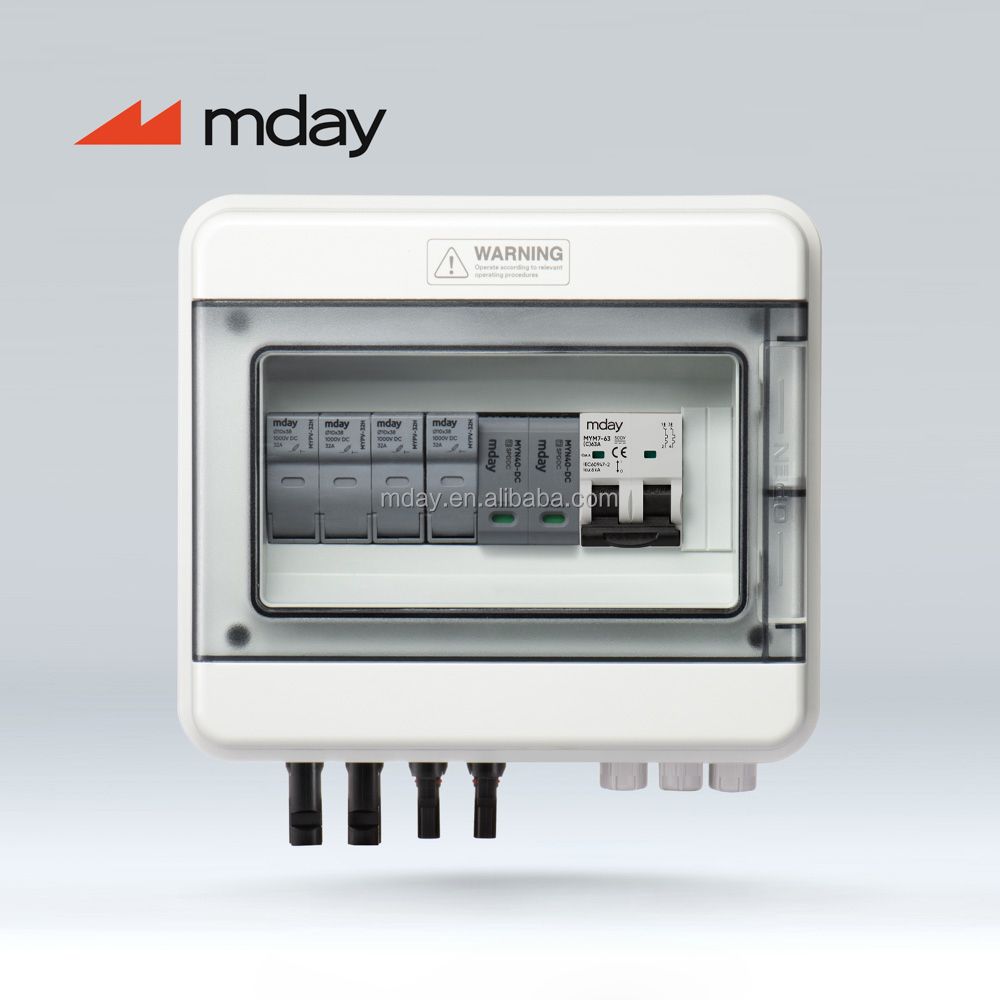
With 3 specialized production lines, dedicated mold tooling capabilities, and over 55 verified technical personnel, we offer end-to-end OEM customization—from custom housing molds to complete pre-wired IP65 solar junction boxes.
Frequently Asked Questions for Industrial B2B Buyers
Address crucial engineering and sourcing queries to ensure optimal system protection and smooth trade operations.
What is the technical distinction between Maximum Continuous Operating Voltage ($U_c$) and Voltage Protection Level ($U_p$)?
Maximum Continuous Operating Voltage ($U_c$ or $U_{cpv}$ for DC systems) represents the maximum RMS or DC voltage that can be continuously applied to the surge protective device without causing it to conduct or degrade. In contrast, the Voltage Protection Level ($U_p$) defines the maximum residual clamping voltage across the terminal terminals during a surge current impulse ($I_n$). For optimal protection, $U_p$ must be at least 20% lower than the impulse withstand voltage ($U_w$) of the sensitive terminal equipment or inverter it protects.
How do I select between a Type 1+2 (Class I+II) and a Type 2 (Class II) SPD for my solar PV facility?
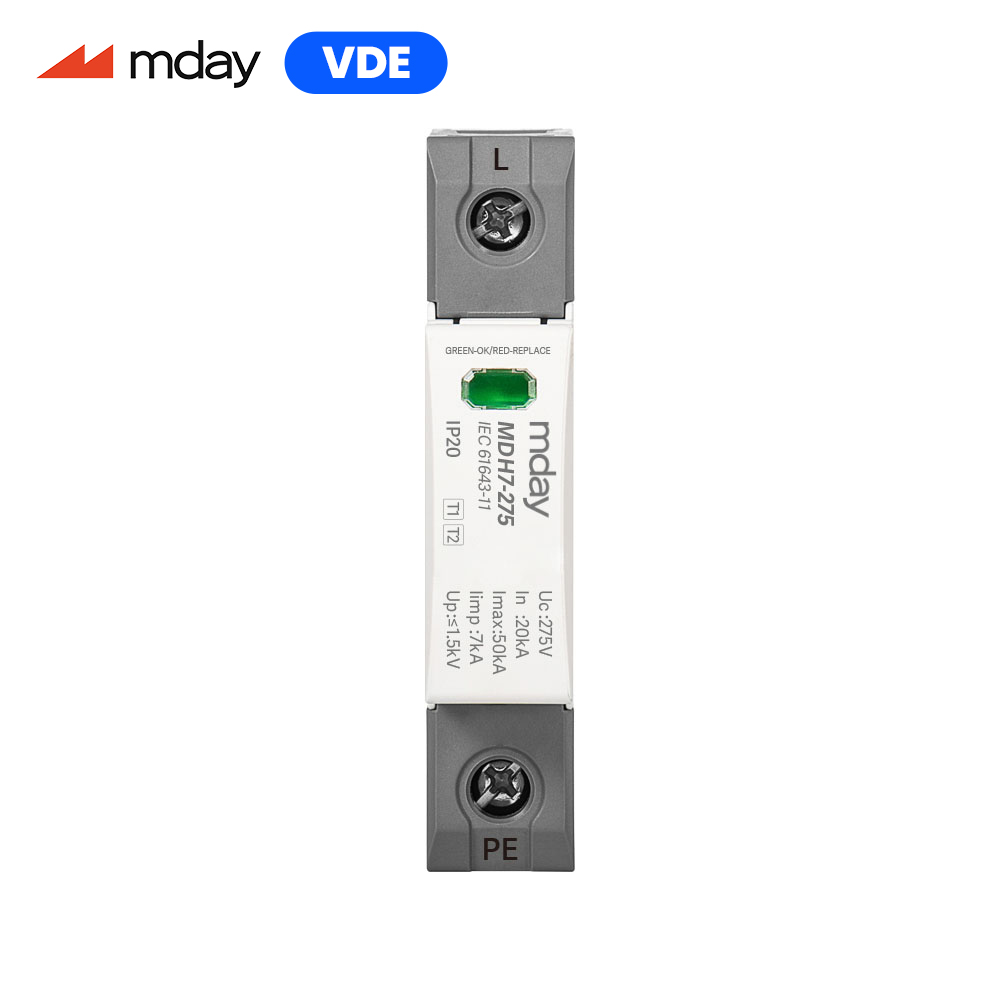
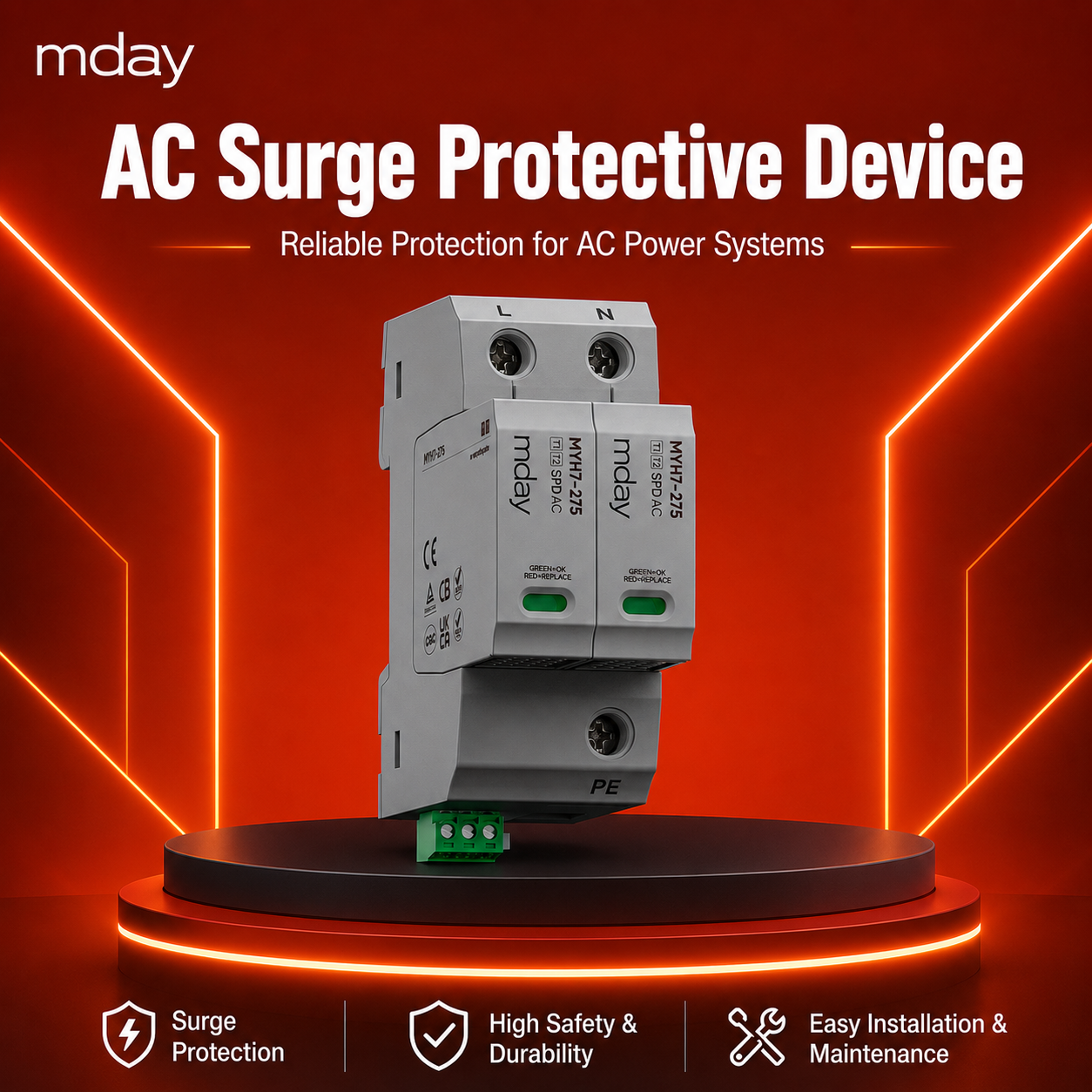
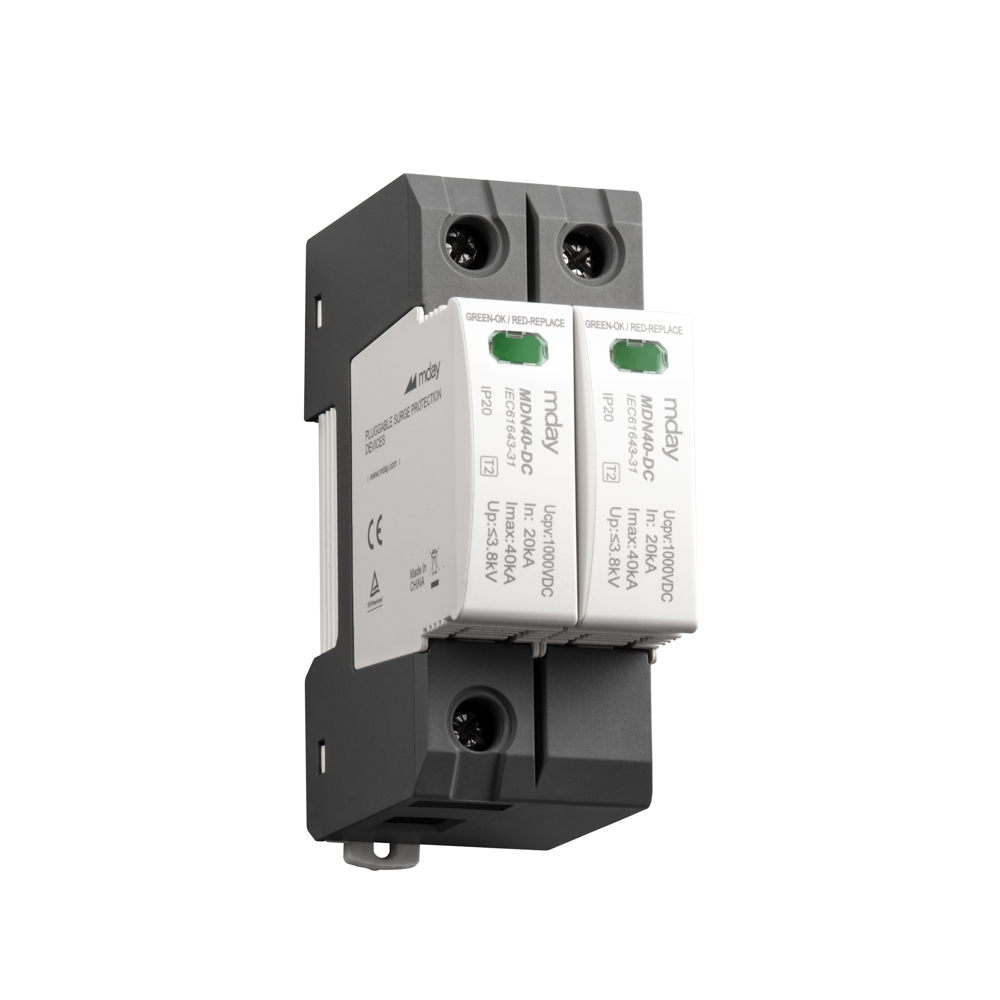
Type 1+2 SPDs (such as the Mday MYH7 series) are mandatory in solar installations equipped with an external Lightning Protection System (LPS) or where direct lightning strikes are likely (LPZ 0A to LPZ 1 boundary), requiring impulse current testing ($I_{imp}$, 10/350 μs waveform). Type 2 SPDs (such as the MLN40-DC series) are recommended for sub-distribution boards, combiner boxes, or string inverters where protection against indirect lightning surges or switching transients (8/20 μs waveform) is required.
What factors influence the service life and thermal degradation of Metal Oxide Varistors (MOVs)?
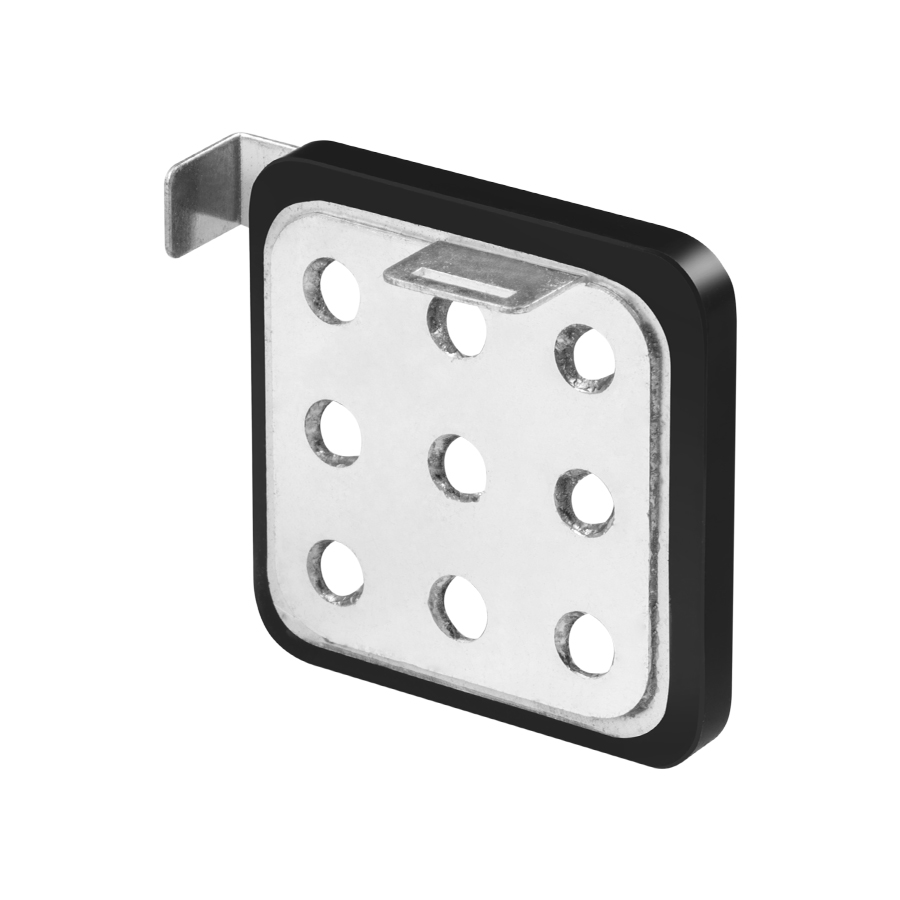
MOVs degrade primarily due to repeated surge energy absorption, environmental ambient temperatures exceeding rated limits, and persistent temporary overvoltage (TOV) events. Each surge absorption event causes microscopic localized puncturing of the zinc-oxide grain boundaries, slightly lowering the varistor breakdown voltage. Tier-1 manufacturers use heavy-duty 34mm square strap-type MOVs (e.g., MDAY MYN34S) combined with internal mechanical thermal disconnector springs to ensure safe isolation before catastrophic thermal runaway occurs.
Why are specialized DC-rated circuit breakers and SPDs required for Photovoltaic and Energy Storage Systems?
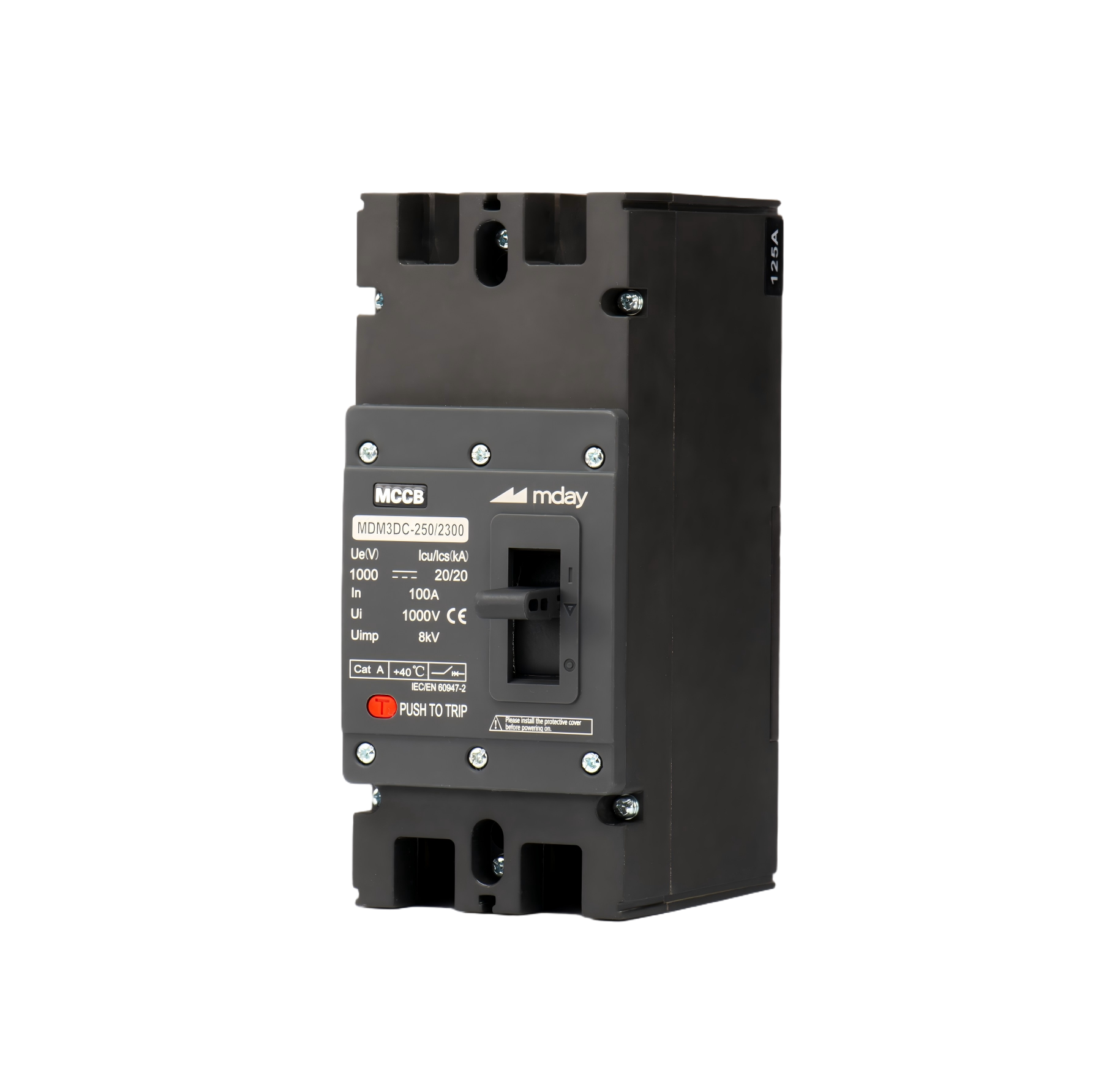
Direct Current (DC) does not possess a natural sinusoidal zero-crossing point like Alternating Current (AC). When a fault occurs, DC electric arcs do not automatically extinguish, making arc interruption exponentially harder. Standard AC breakers or SPDs installed on DC circuits will fail to quench arcs, creating extreme fire hazards. Specialized DC components—such as the Mday MDM3DC 250A MCCB and MLN40 DC SPD—feature magnetic arc blow-out coils, extended arc chutes, and multi-pole series wiring to safely clear high-voltage DC faults up to 1500V DC.
What standard OEM / ODM customization services does Luck New Energy provide to international distributors?
We offer full design-based and sample-based OEM/ODM services backed by 7+ years of experience. Customization options include custom shell printing, private brand laser etching, color modifications, specific continuous operating voltage ($U_c$) tuning, tailored MOV response times, custom breaking capacity ratings for DC fuses/breakers, and pre-wired custom IP65 junction box assemblies. Standard sample lead times range from 2 to 7 days.
What quality control procedures guarantee that shipped batches meet certified parameters?
Quality assurance is governed by ISO9001 management protocols. Raw incoming materials (varistor blocks, silver-plated copper terminals, flame-retardant PC/ABS plastics) undergo strict incoming quality checks (IQC). In-process quality control (IPQC) operates across our 3 automated production lines. Before shipment, 100% of finished SPDs undergo automated voltage breakdown ($V_{1mA}$) testing, leakage current measurement, and visual thermal trip window verification.
Accelerate Your Industrial Protection Supply Chain
Partner directly with an onsite TÜV-verified factory. Get expert engineering support, custom VDE/TÜV certified SPD samples, and factory-direct wholesale quotations within 24 hours.
