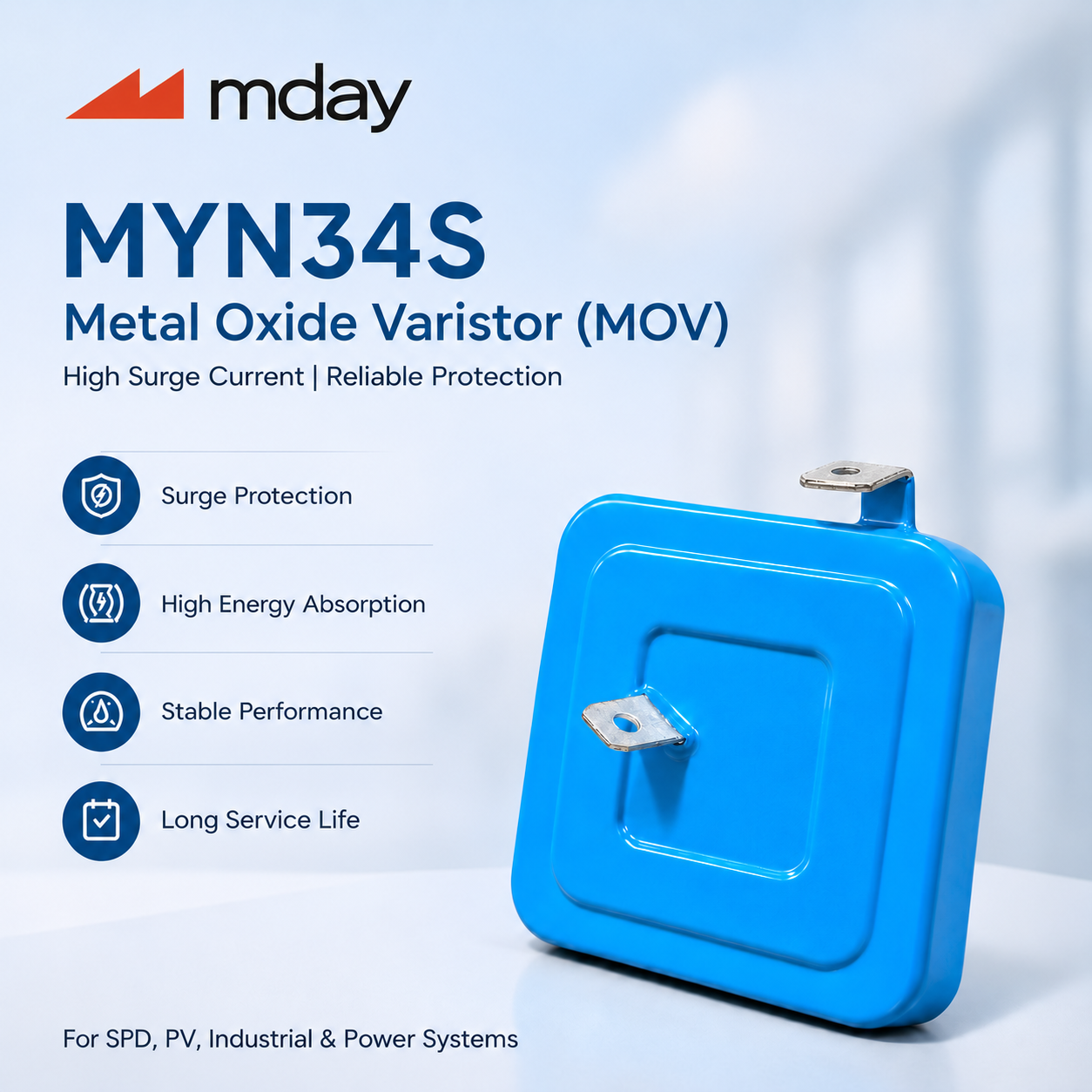
Mday MYN34S 34mm Square Metal Oxide Varistor MOV 275VAC 40kA 8/20μs for SPD Surge Protection TÜV Certificate
A core component for reliable SPD assembly, with high energy absorption and thermal stability.
275VAC40kATÜV certificate
These eight product families are selected for procurement teams building a complete DC protection bill of materials — from SPD assembly and string fusing to isolation, surge protection and high-voltage DC switching.
A core component for reliable SPD assembly, with high energy absorption and thermal stability.
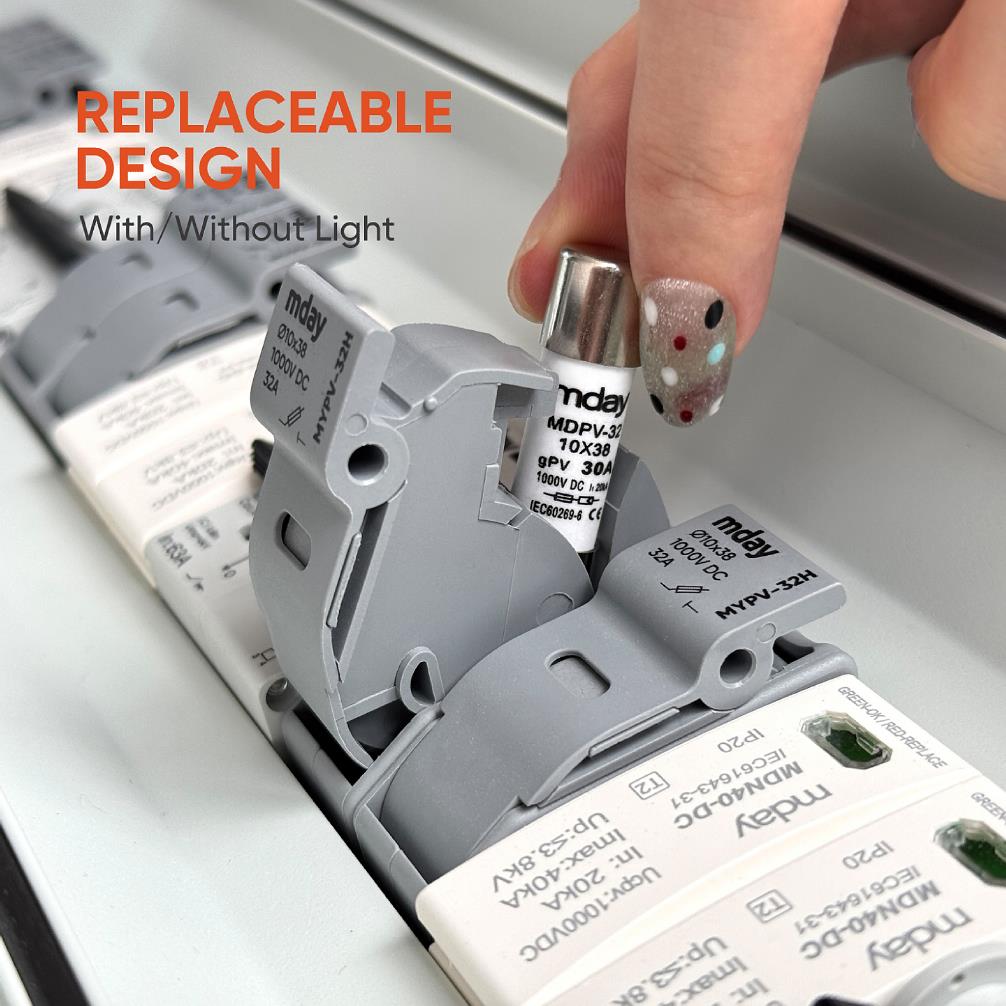
Designed for high-voltage string protection and utility-scale PV combiner assemblies.
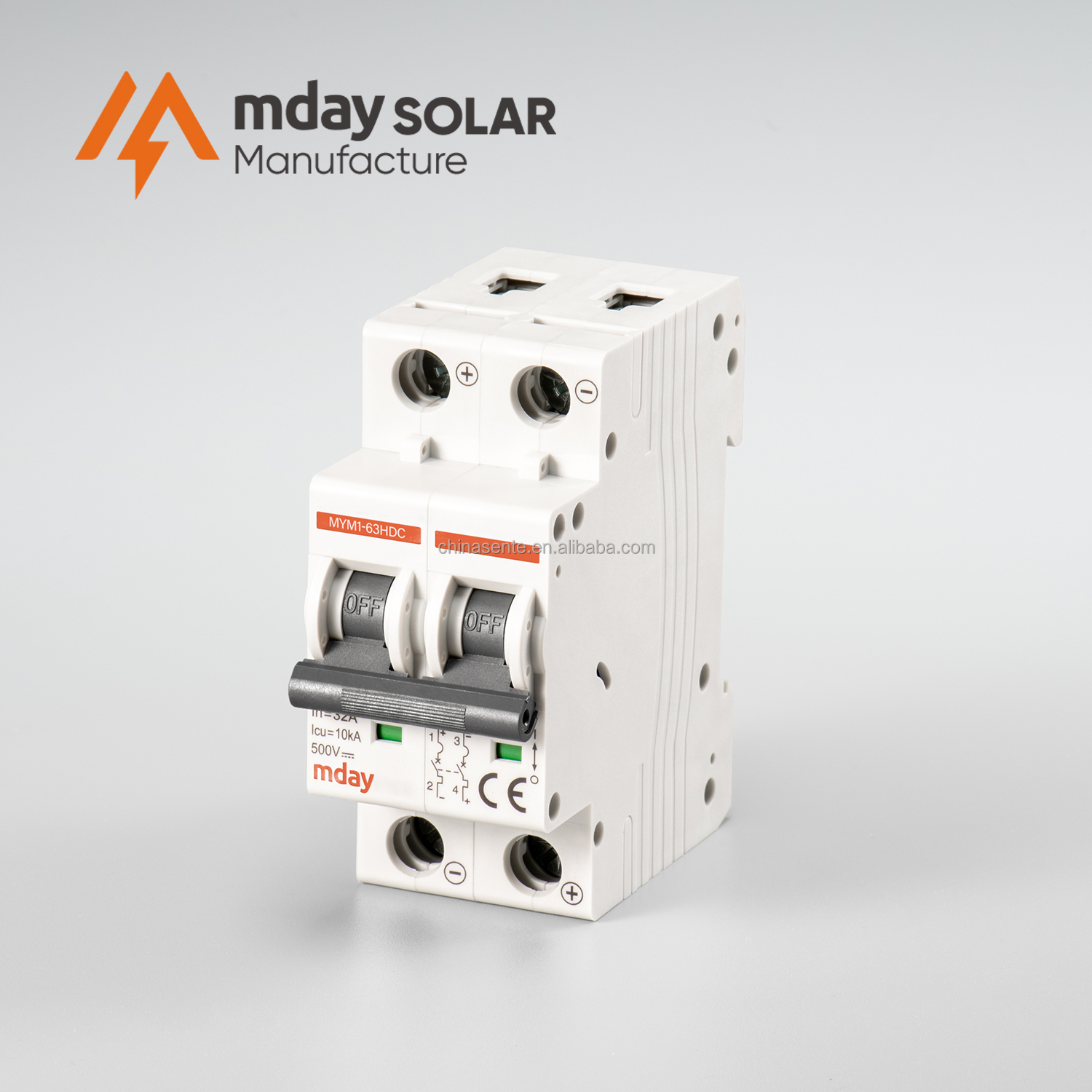
A flexible 1000V DC breaker platform for string, inverter and distribution applications.
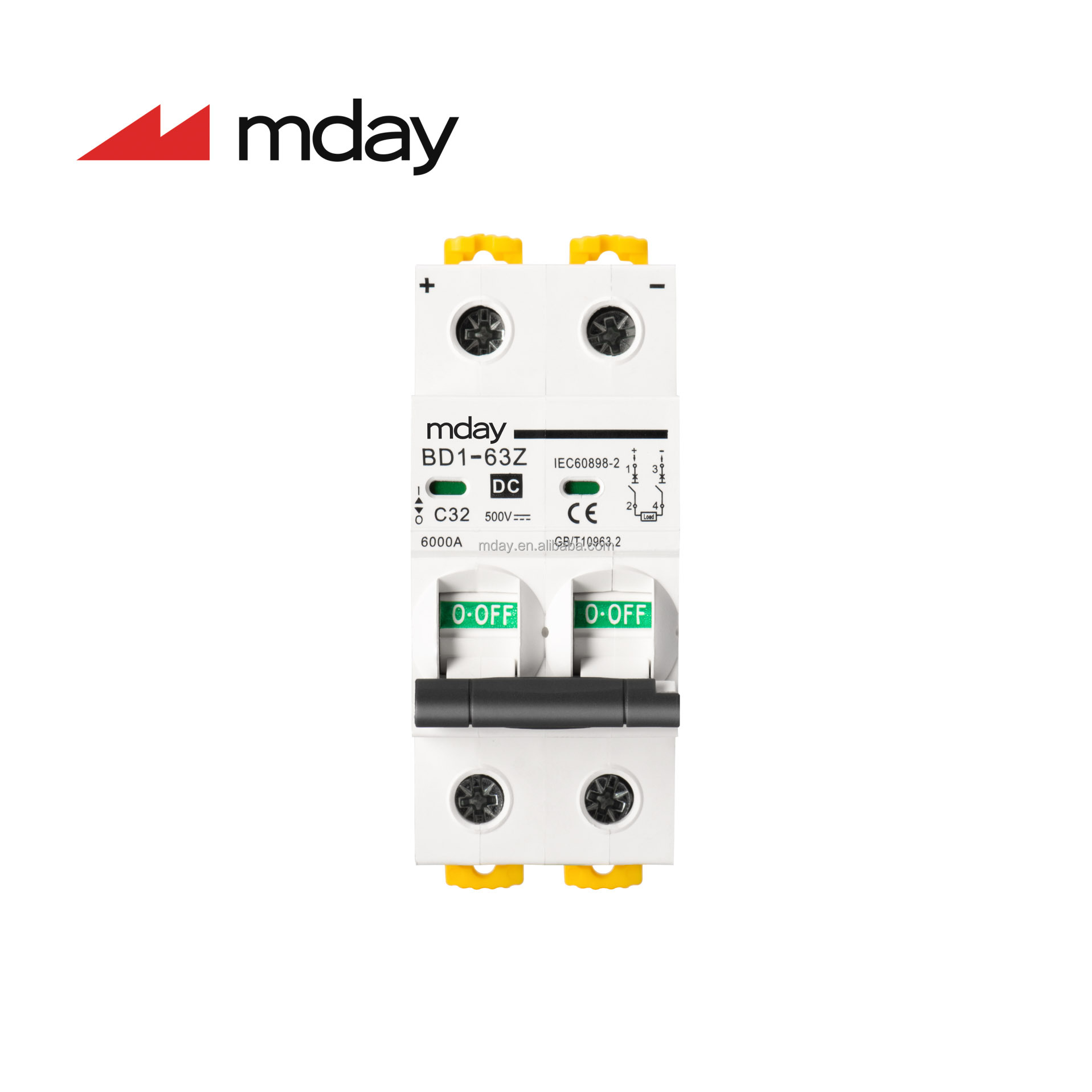
A compact DC MCCB solution for battery, inverter and industrial DC feeder protection.
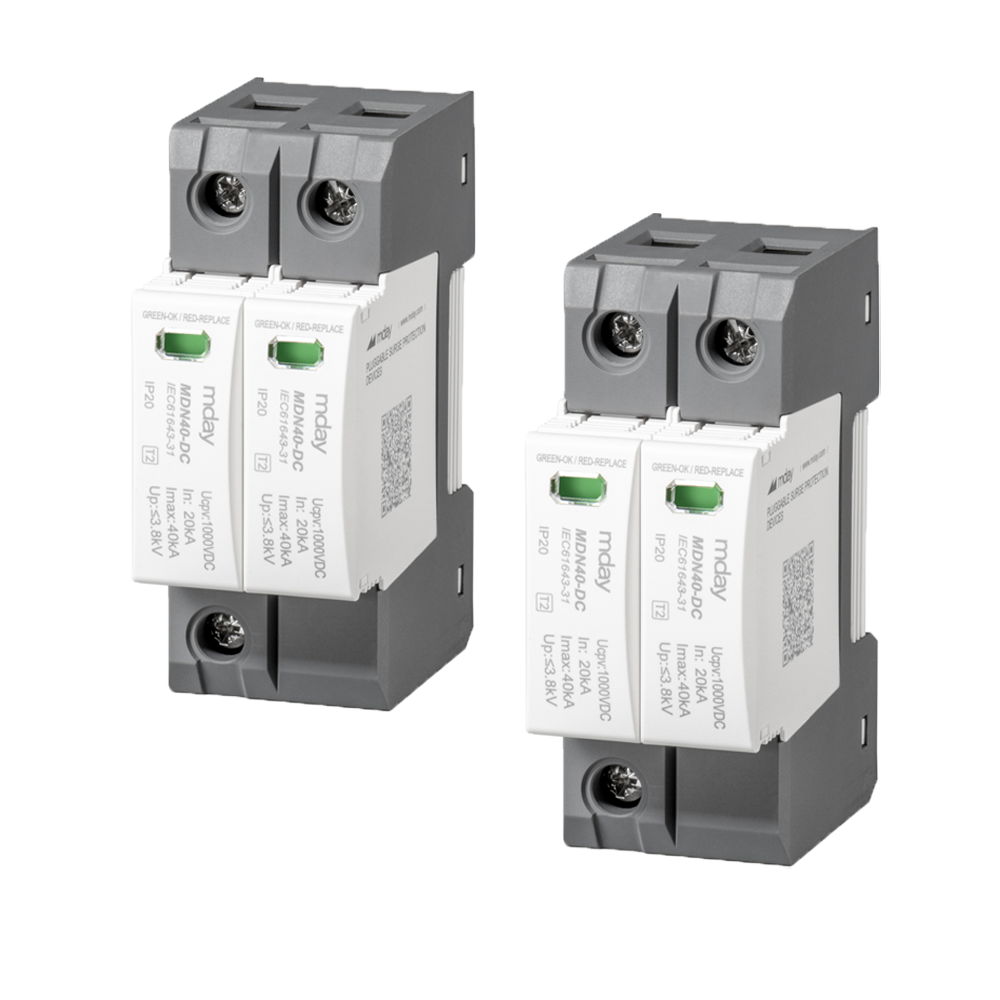
Type 2 DC SPD protection for PV arrays exposed to induced surges and lightning activity.
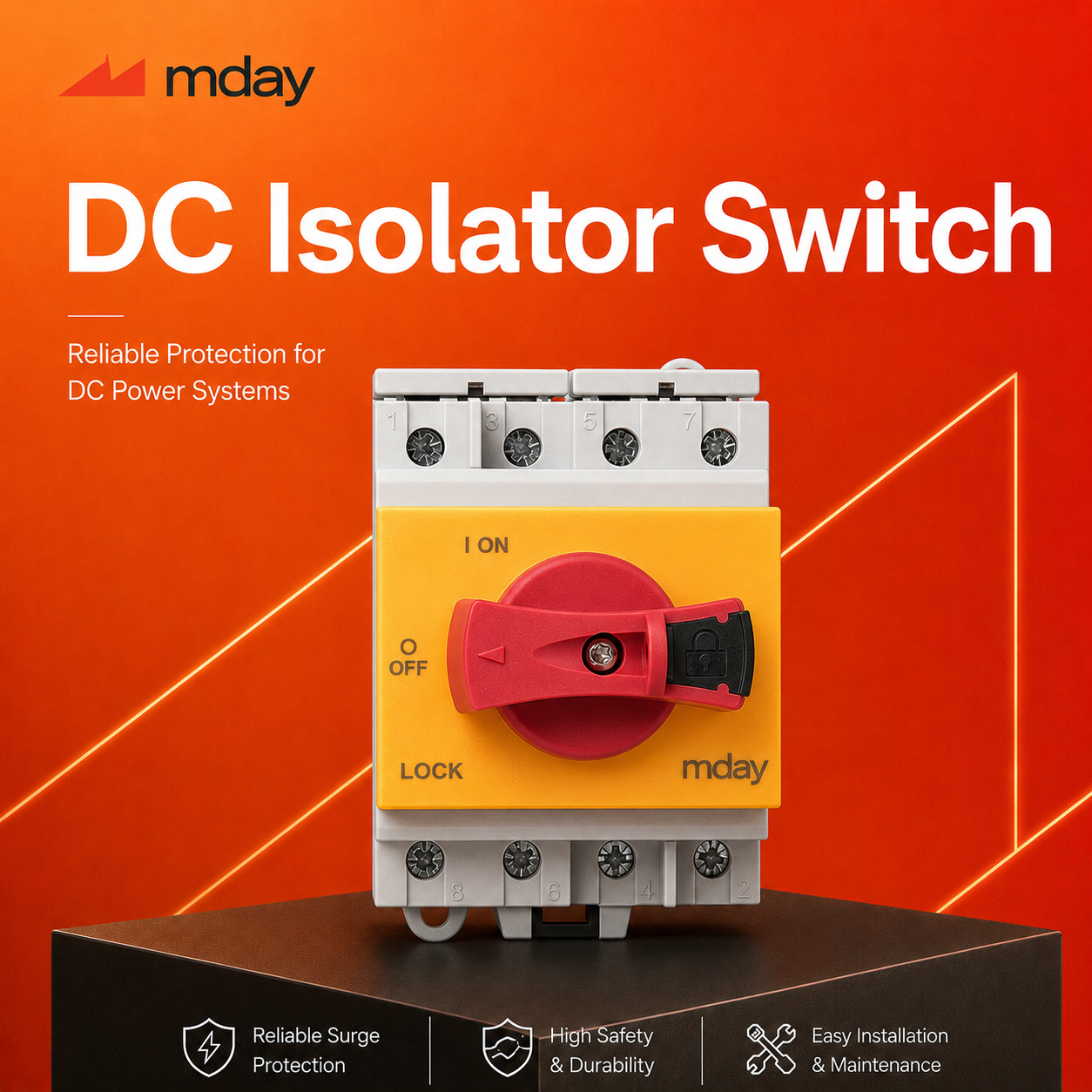
A visible-break isolation solution for safe PV array maintenance and emergency shutdown.
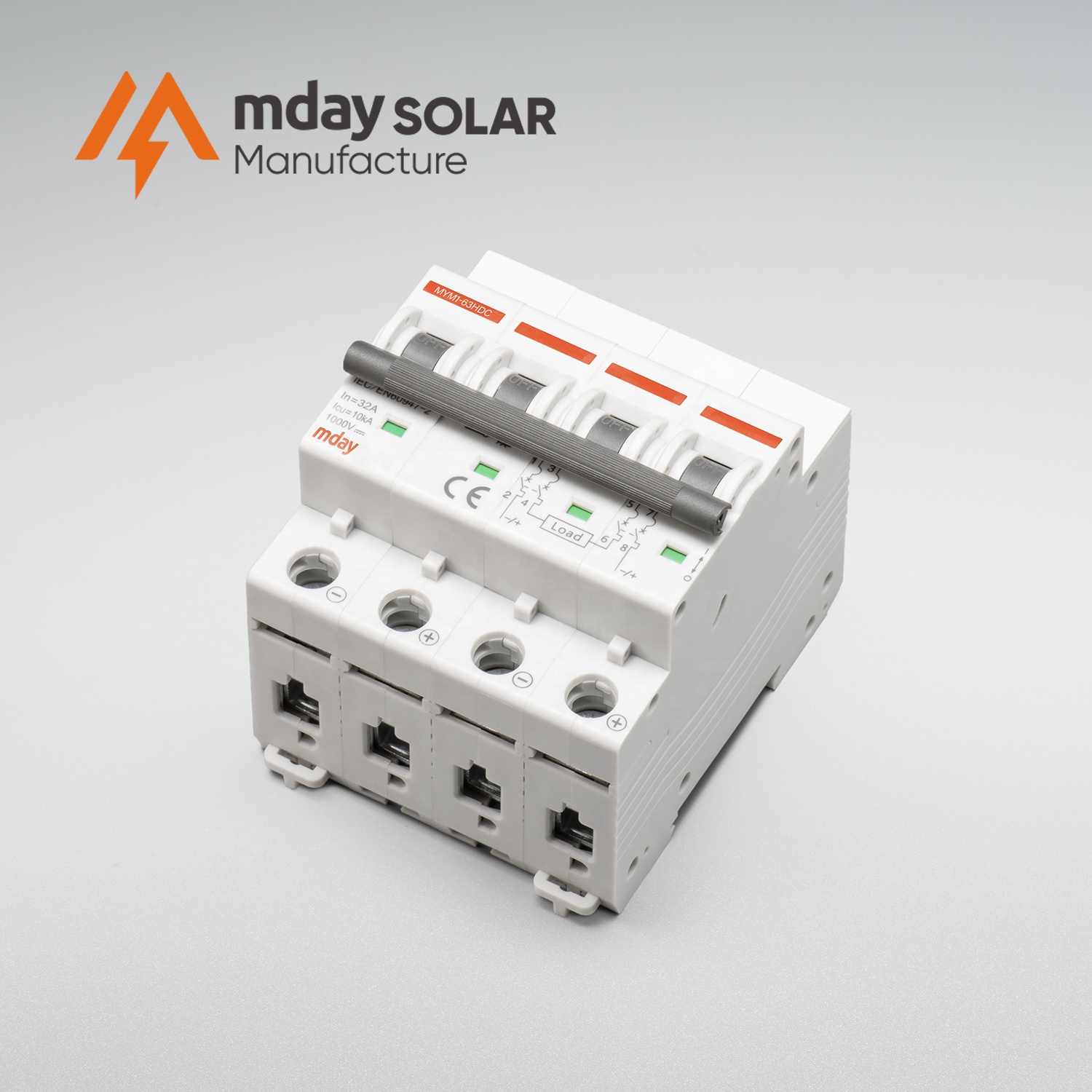
A CE-marked 1000V DC MCB for high-voltage solar strings, combiner boxes and DC panels.
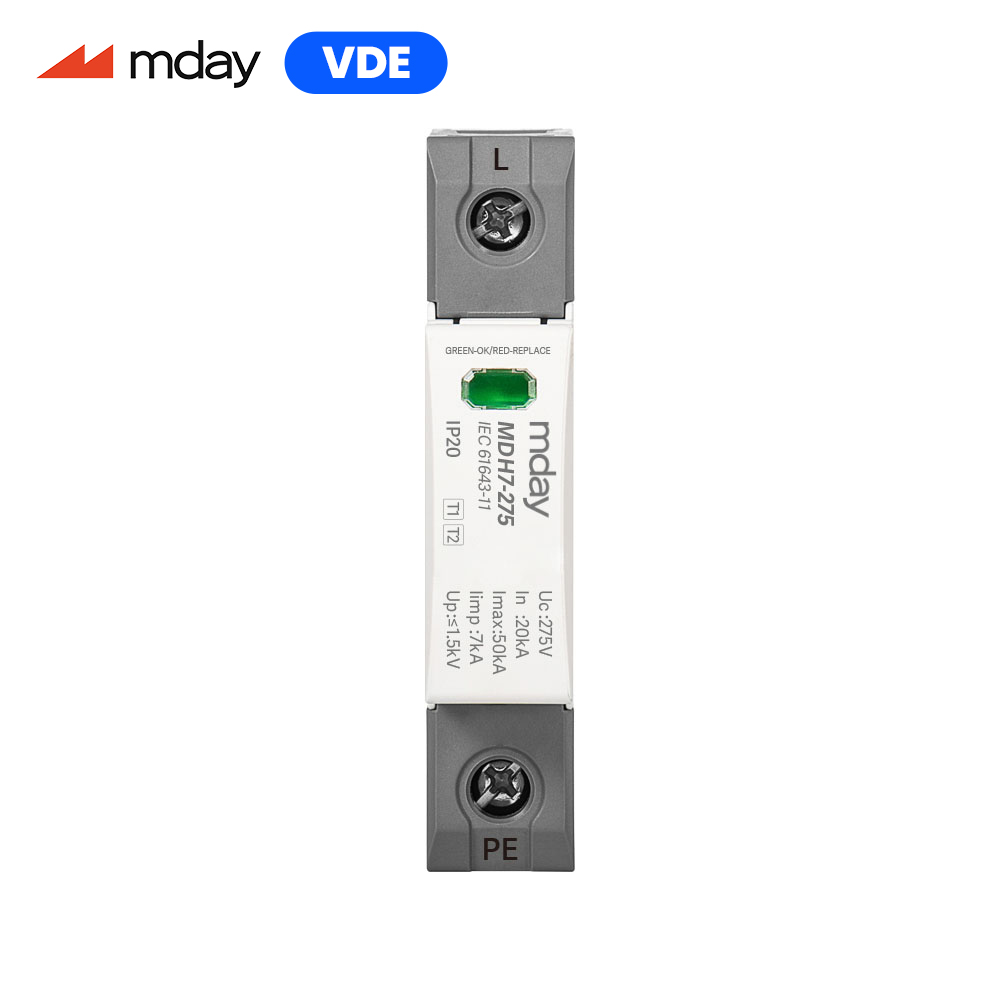
AC-side surge protection for inverter output, distribution boards and industrial equipment.
A DC miniature circuit breaker is not simply an AC breaker with different printing. In solar arrays, batteries and EV-charging infrastructure, a DC fault does not pass through a natural zero crossing. The breaker must extinguish a sustained DC arc, manage thermal stress and remain predictable after years of outdoor temperature cycling. That is why serious buyers look beyond the phrase “CE certified” and ask for the technical file behind the mark.
For industrial DC protection, the relevant reference is usually IEC/EN 60947-2, supported by a declaration of conformity, test reports and clear DC ratings. The CE mark itself is a manufacturer’s declaration, not a certificate issued by a notified body. A credible CE Certified DC MCB Circuit Breaker Supplier & Wholesaler should therefore provide the declaration of conformity, rated voltage, rated current, breaking capacity, pole configuration, trip curve, torque specification and traceability information. This is the practical evidence a distributor, EPC contractor or panel builder needs when local authorities or end clients audit a project.
For 1000V and 1500V solar systems, voltage rises at low ambient temperature. A string designed at 950V may exceed 1000V on a cold morning, so the breaker’s DC voltage rating, number of poles in series and installation instructions matter. In battery energy storage, fault current may flow in either direction, and coordination with fuses, SPDs and contactors becomes part of system safety. Luck (zhejiang) New Energy Co., Ltd. supports buyers with product selection, sample evaluation and documentation review so that the purchased breaker matches the actual DC architecture — not only the purchase order.

Use this practical selection map to align DC MCB, MCCB, SPD and isolation products with the risk point in your solar or energy storage system.
Choose a 1000V or 1500V DC MCB with 2P or 4P configuration, 6kA breaking capacity and a trip curve matched to the string current. The L7 1000V DC 4-pole MCB is suited to combiner boxes and high-voltage solar distribution.
View solar PV MCBFor battery links, inverter inputs and industrial DC feeders, use a compact DC MCCB with verified voltage ratings and thermal-magnetic protection. The MQC-63DC 2P 250V–1000V MCCB offers a practical balance of size, 6kA breaking capacity and DIN rail installation.
View DC MCCBLong DC cables act as antennas for induced surges. Pair Type 2 DC SPDs with the PV array and use AC SPDs at inverter output or distribution boards. The Mday T2 DC surge protection device supports solar lightning protection strategies.
View DC SPDUse a visible-break DC isolator for maintenance safety and a 1500V DC fuse holder for high-energy string protection. The MYPV32-L2 1200V DC isolator combines IP66 protection with a red rotary handle for clear status indication.
View DC isolatorPurchasing decisions are shifting from single-unit price comparison to total system risk, documentation quality and supply resilience. These four trends are shaping RFQs in 2025 and beyond.
Utility PV and commercial storage are pushing DC voltages higher. Buyers increasingly request 1500V DC fuse holders, higher-voltage DC breakers and components suitable for bidirectional energy flow. A supplier that understands both PV and battery architectures can reduce mismatched BOM risk.
Procurement teams now ask for a package: CE declaration of conformity, IEC/EN test reports, RoHS information, rated DC data, installation instructions and batch traceability. This documentation bundle protects distributors during local inspections and gives EPC contractors stronger project handover files.
Brand owners and regional distributors want their own label, packaging, colour and ratings without committing to container-scale inventory. A wholesale supplier with 7 years of OEM experience and MOQ from 5 to 200 pieces helps buyers test new markets while keeping working capital under control.
Instead of sourcing SPD from one trader, fuses from another and DC MCBs from a third, buyers consolidate the protection chain with one manufacturer. This reduces communication cost, improves compatibility between SPDs, fuses and breakers, and simplifies after-sales documentation for solar and energy storage projects.
Product development is moving toward safer DC interruption, easier system coordination and better data for installers and asset owners.
Designers are optimising arc chutes, contact materials and thermal calibration so that a DC MCB remains stable in high ambient temperatures. For buyers, the practical check is not only the printed current rating, but also the temperature derating curve and the recommended torque.
Solar plus storage systems require breakers and fuses that consider reverse current. Product roadmaps are moving toward 1500V DC accessories, wider pole combinations and clearer polarity marking. Buyers should confirm whether the device is intended for PV string protection, battery isolation or general DC distribution.
Manufacturers are expanding auxiliary contacts, shunt trips, busbars and DIN rail accessories. This helps panel builders reduce assembly time and improve maintenance. A coherent accessory system is becoming a selection factor alongside the breaker itself.
EU and international buyers increasingly expect material declarations, packaging optimisation and batch-level traceability. Suppliers that maintain consistent test records and clear product labelling can shorten qualification cycles and reduce compliance risk for distributors.
Luck (zhejiang) New Energy Co., Ltd. combines low-voltage protection manufacturing experience with export-ready documentation for solar, storage and industrial buyers.
Our facility in Yueqing Economic Development Zone, Wenzhou has been assessed onsite by TÜV Rheinland. Buyers can review third-party supplier credentials rather than relying only on self-declared capability statements.
With more than 12 years in protection components and 7 years of OEM experience, we support private label, custom ratings, housing colours, packaging and pre-configured protection solutions for distributors and brand owners.
Nine testing instruments, three QC staff and 100% finished-product inspection support consistent quality. Incoming material checks and in-process inspection on three production lines help catch issues before shipment.
Our portfolio includes VDE-certified SPD models, TÜV-certified MOV components, fuse holders built to UL 248-19 and IEC 60269-6, and DC MCBs following IEC/EN 60947-2 with CE marking. Documentation can be prepared for buyer review.
Standard models typically ship within 2–7 days, with MOQ ranging from 5 to 200 pieces depending on the model. Three production lines and functional workshop organisation support stable repeat-order scheduling.
Around 70% of output serves overseas markets, with a 4.8/5 buyer rating and experience serving Europe, Southeast Asia, Latin America, the Middle East and CIS markets. English-speaking trade staff support RFQs and export documentation.
Our production workflow is organised by function, with inspection points that help protect buyers from batch-to-batch variation.
Key materials such as contacts, housings, MOV elements and terminals are checked before production. This helps reduce hidden defects that may only appear during high-current interruption or long-term temperature cycling.
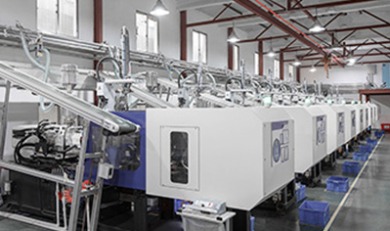
Three production lines operate with in-process checks at defined stages. Functional workshop organisation and automated assembly stations improve repeatability for SPDs, fuses, DC breakers and isolators.
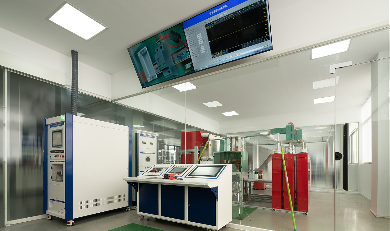
Nine in-house testing instruments support routine verification. For DC MCB and protective devices, correct calibration and clear rating marking are essential for installation safety and system coordination.
A dedicated QC team performs 100% finished-product inspection. Batch records, product labels and packaging information help distributors respond to customer questions and maintain after-sales traceability.
These are the questions procurement teams ask most often before placing a first order with a CE Certified DC MCB Circuit Breaker Supplier & Wholesaler.
Yes. We can provide CE declaration of conformity, product data, rated DC specifications and available test documentation for the selected model. The CE mark is a manufacturer’s declaration supported by technical documentation; it is not the same as a third-party certificate. Our team will clarify which reports are available for your exact model and target market before you order.
Typical options include 1–63A DC MCBs with 1000V DC ratings, 2-pole and 4-pole configurations, 6kA breaking capacity, and compact DC MCCBs such as the MQC-63DC 2P 250V–1000V 6kA range. We also supply 1500V DC fuse holders, 1200V DC isolators, DC SPDs and AC SPDs so buyers can consolidate the protection BOM.
Start with the maximum system voltage at the lowest expected ambient temperature, not only the nominal voltage. Confirm string short-circuit current, required poles in series, installation altitude, enclosure temperature, breaking capacity and coordination with fuses or SPDs. Send your single-line diagram, string configuration and target standard to our engineers; we will recommend a practical model for review and sample testing.
Yes. We provide full customization, design-based customization and sample-based customization, including private labels, custom ratings, housing colours, packaging and pre-wired combiner box configurations. With 7 years of OEM experience, we support distributors and brand owners who need a factory partner rather than a trading company.
MOQ ranges from 5 to 200 pieces depending on the model. Standard models typically ship within 2–7 days; customized orders are scheduled after sample approval. Quality control includes incoming material checks, in-process inspection on three production lines, nine in-house testing instruments and 100% finished-product inspection by a dedicated QC team.
We accept T/T, L/C, D/P, Western Union, PayPal and cash. To receive an accurate quotation, share the model, DC voltage, rated current, pole count, breaking capacity, target certification, annual quantity and packaging preference. Use the inquiry button below to start the conversation with our export team.
Send your system voltage, current rating, pole configuration, target standard and estimated order quantity. Our team will recommend a matching DC MCB, DC MCCB, SPD, fuse or isolator configuration and support sample evaluation before mass production.
