Precision Electrical Protection & Switching Solutions
Explore our flagship VDE, TÜV, and CE-certified circuit breakers, surge protectors, and isolation switches engineered by Luck (Zhejiang) New Energy Co., Ltd.
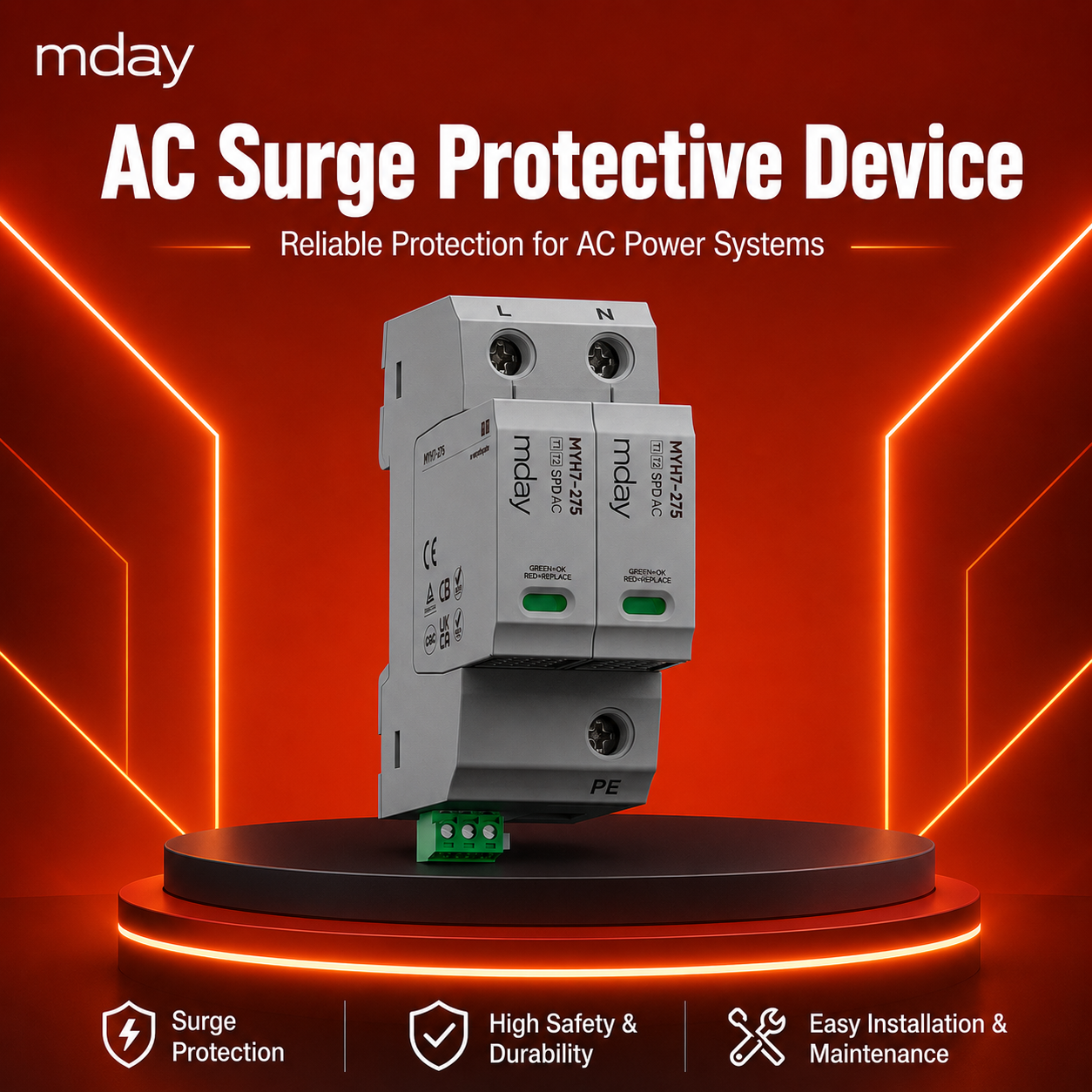
Mday T2 MYN40 VDE-Certified 20/40kA AC SPD Surge Protector Device
- Rated Surge: 20kA / 40kA (8/20µs)
- Standards: IEC 61643-11 / VDE Approved
- Modular Plug-In Din-Rail Structure

Mday 4-Pole IP66 Isolator Switch 1200V DC 32A Rotary PV Disconnect Switch
- Max Voltage: 1200V DC / 1000V DC
- Current Rating: 32A Continuous Load
- IP66 Enclosure for Extreme Outdoor PV
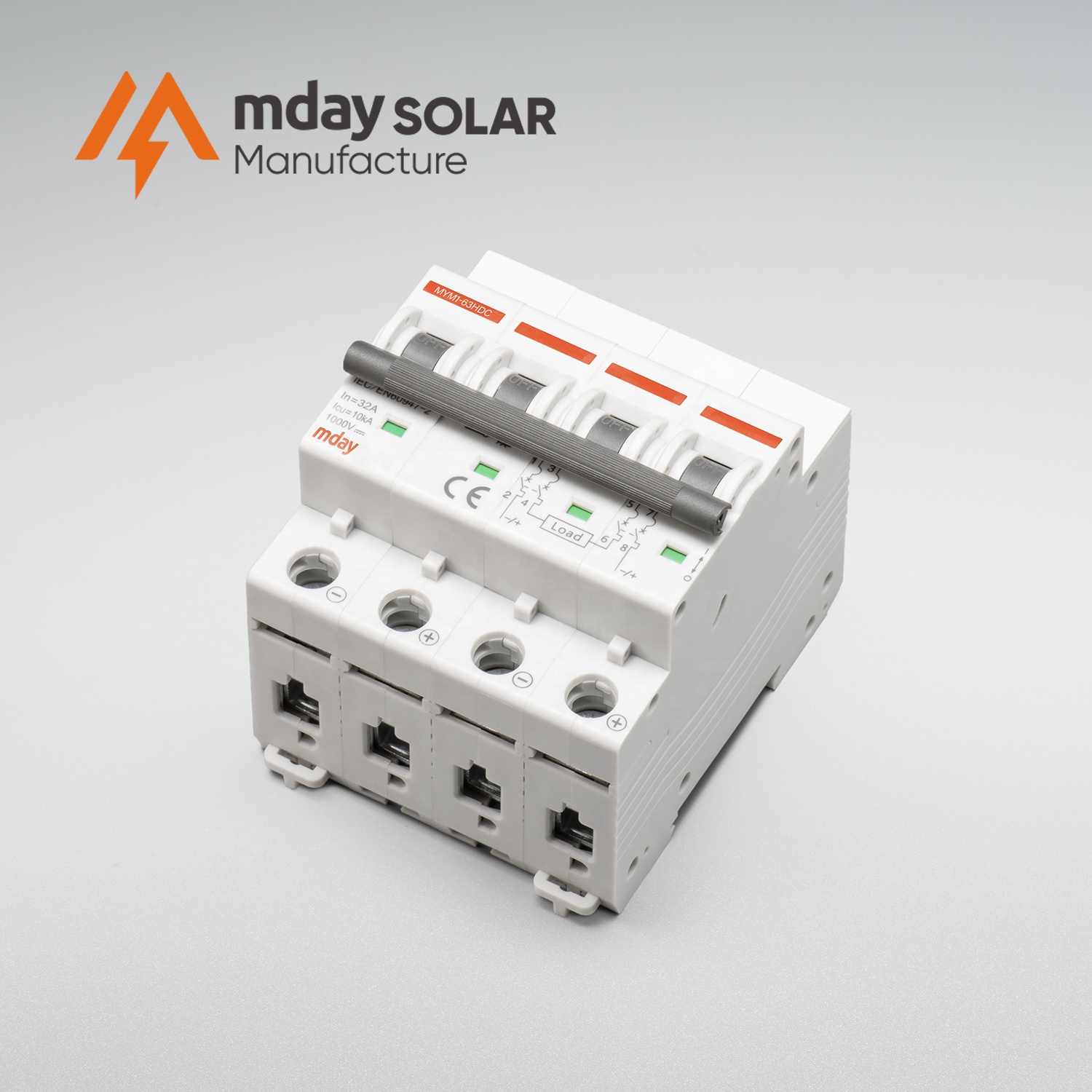
IEC CE Approved Solar PV MCB L7 4-Pole 50-63A 6kA 1000V DC Circuit Breaker
- Rated Voltage: 1000V DC 4-Pole
- Breaking Capacity: 6kA (IEC/EN 60947-2)
- Tripping Curve C for Solar String Isolation
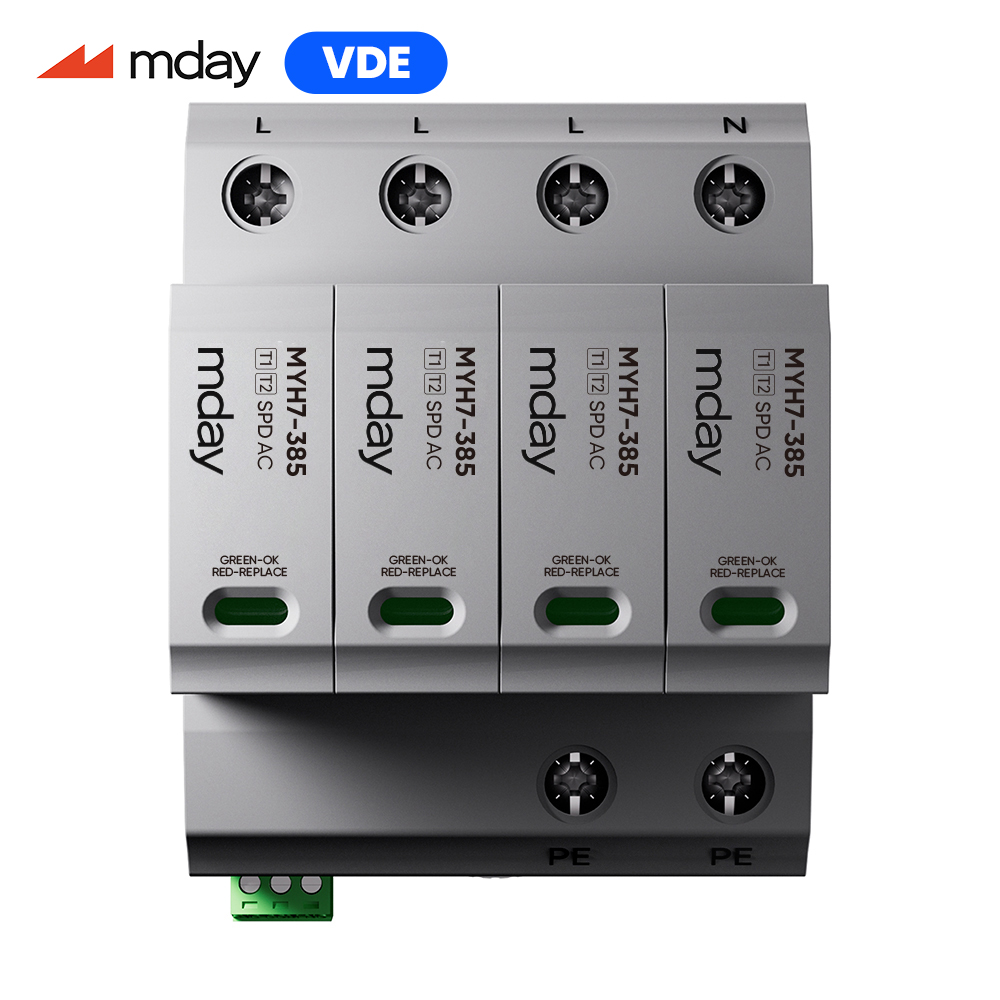
Mday T1+T2 MYH7 4P 385V VDE-Certified AC SPD Lightning Surge Protectors
- Combined Protection: Class I + Class II
- Max Continuous Voltage: 385V AC
- VDE / CE Tested for High Lightning Risk
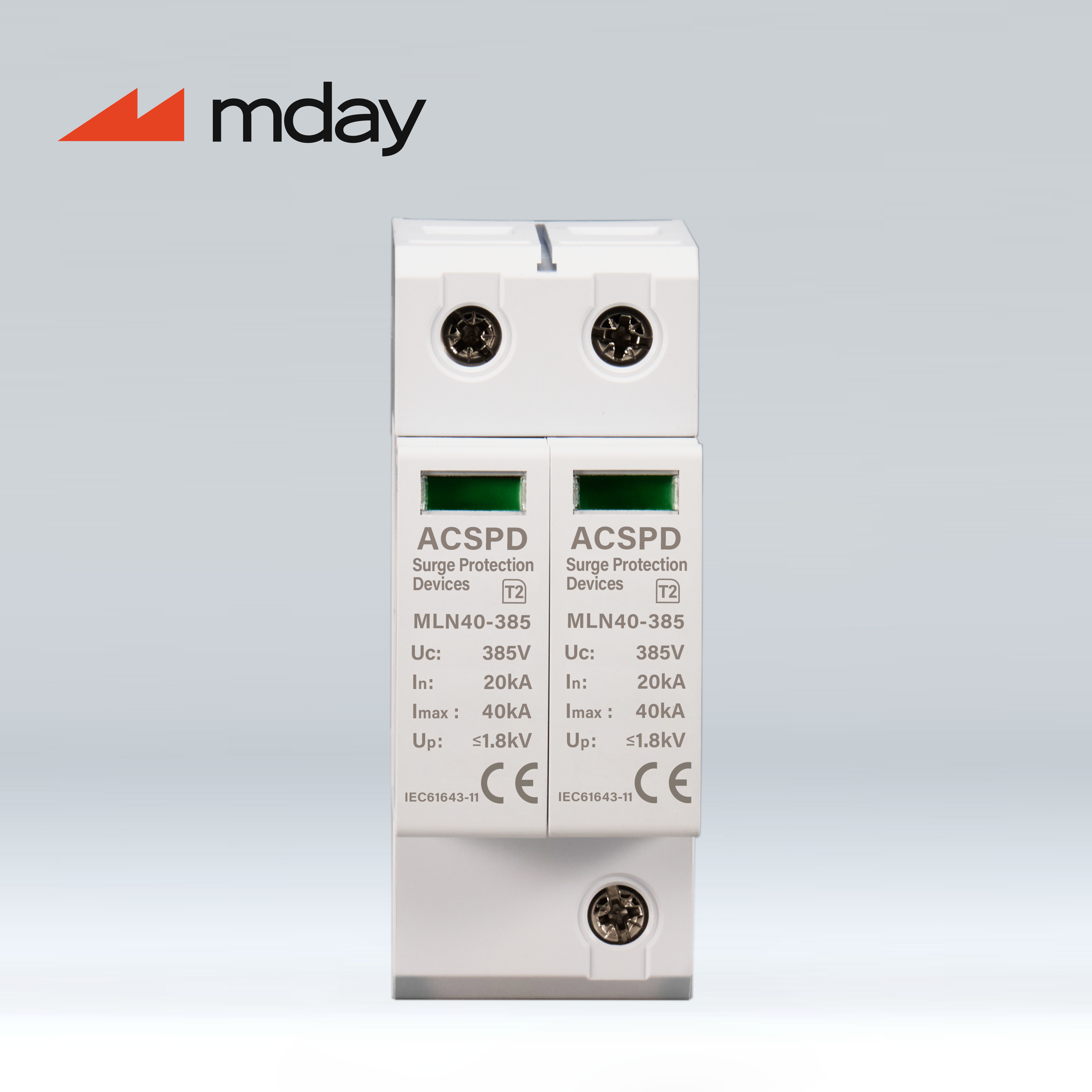
MLN40 T2 AC SPD 1P 2P 3P 4P Surge Protection Device 40KA Din Rail
- Configurable Poles: 1P, 2P, 3P, 4P
- Max Discharge Current: 40kA
- Rapid Thermal Disconnector Response

Mday DIN Rail ATS PC Class Dual Power Automatic Transfer Switch 2P 63A-125A
- Classification: PC Class High Reliability
- Rated Current: 63A, 100A, 125A
- Seamless Grid-to-Generator Switch
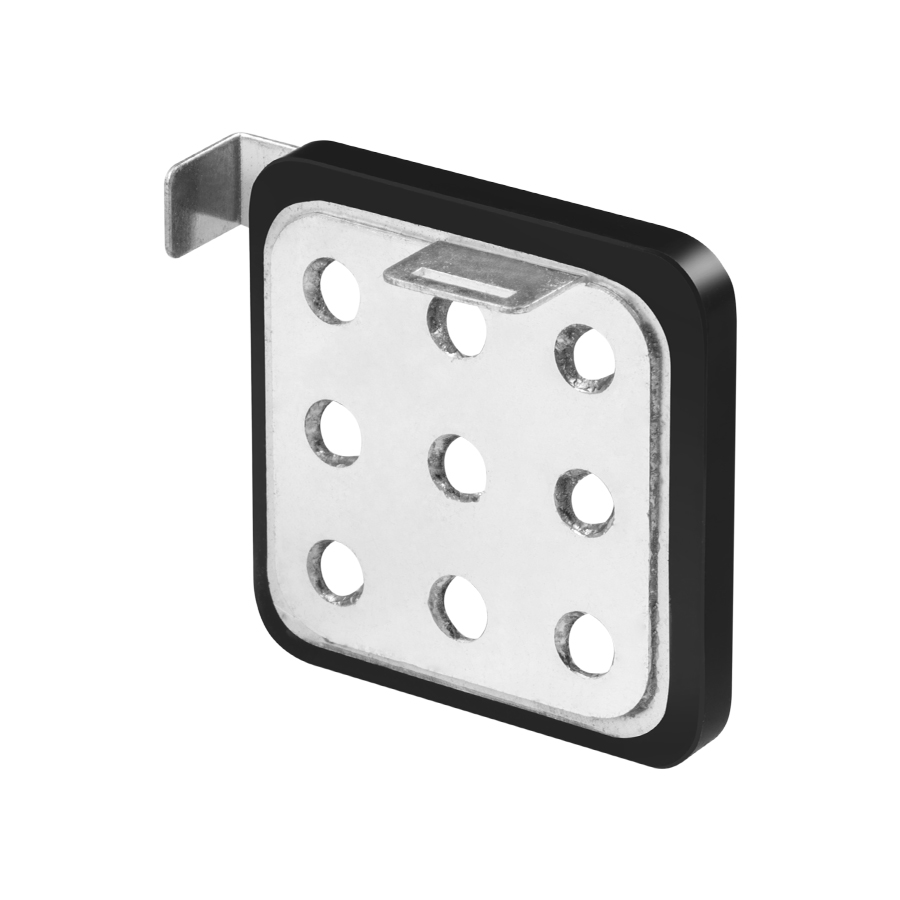
MDAY MYN34S Metal Oxide Varistor (MOV) Strap Type for SPD Manufacturing
- Element Size: 34mm Square Ceramic Block
- High Surge Capacity: 40kA 8/20µs Impulse
- Low Clamping Voltage & TÜV Verified
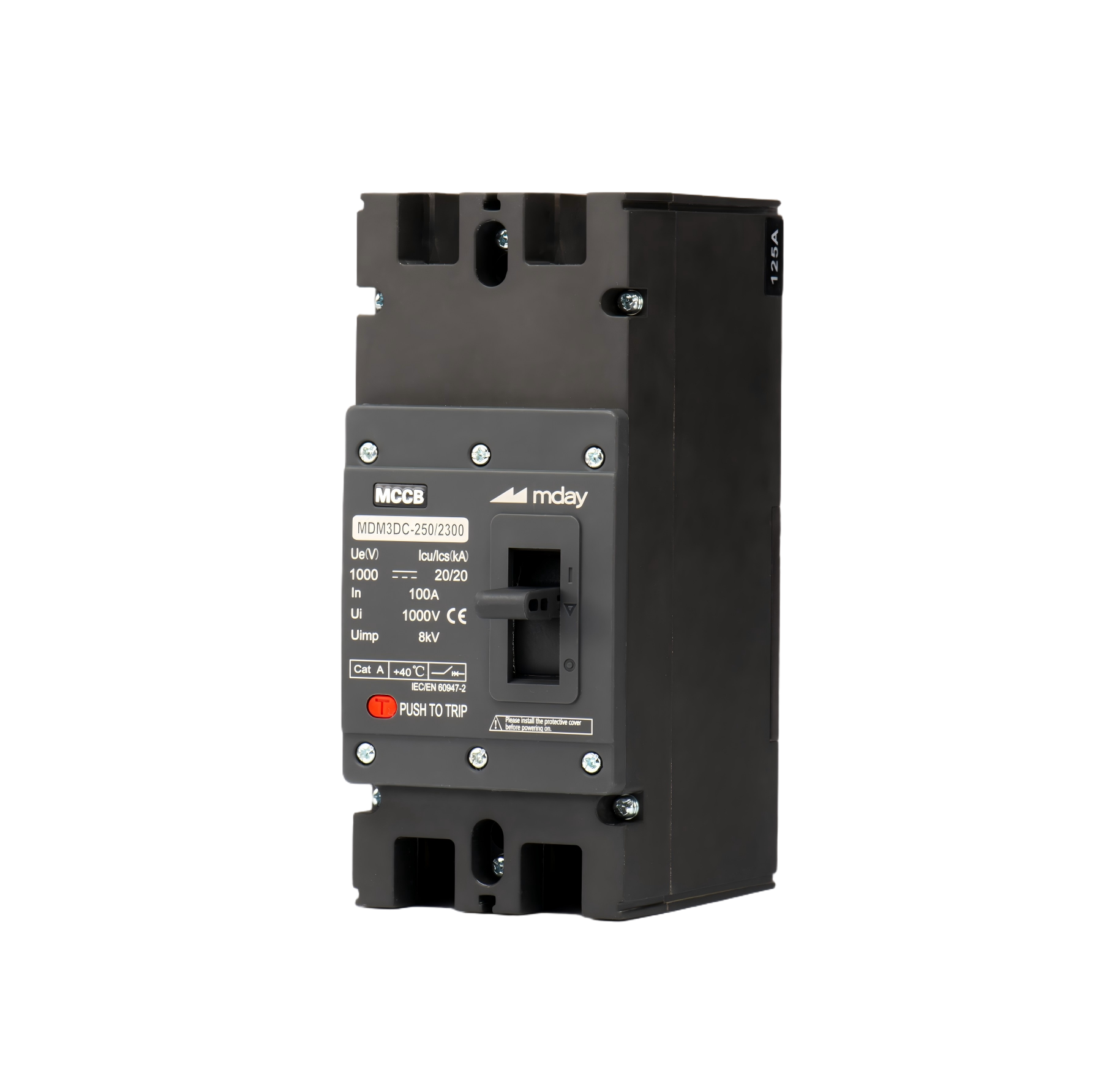
Mday MDM3DC-250 2P 500V 250A 20kA Thermal-Magnetic DC Moulded Case Breaker
- Voltage & Current: 500V DC / 250A
- Ultimate Breaking Capacity: 20kA ($I_{cu}$)
- IEC 60947-2 Standard Heavy Duty Frame
Engineering High-Reliability Molded Case Circuit Breakers (MCCBs) for Modern Photovoltaic & Energy Storage Infrastructures
An authoritative breakdown of low-voltage DC arc extinction, thermal-magnetic trip dynamics, dielectric isolation, and critical procurement criteria for utility-scale solar and commercial distribution systems.
In modern industrial and utility electrical engineering, the Molded Case Circuit Breaker (MCCB) represents the fundamental cornerstone of overcurrent protection, system isolation, and short-circuit fault mitigation. Unlike standard residential miniature circuit breakers (MCBs), MCCBs are specifically engineered to accommodate high current magnitudes—ranging typically from 63A to over 1600A—while handling massive ultimate short-circuit breaking capacities ($I_{cu}$) up to 100kA at AC voltages and up to 20kA/33kA at elevated DC potential (500V DC to 1500V DC).
As the global energy transition shifts rapidly toward high-voltage direct current solar arrays, battery energy storage systems (BESS), and EV fast-charging microgrids, China has emerged as the premier global manufacturing hub for low-voltage power distribution apparatus. Navigating the competitive OEM and supply landscape requires deep technical clarity into how advanced Chinese manufacturers like Luck (Zhejiang) New Energy Co., Ltd. optimize contact geometry, magnetic blowout arc chute mechanisms, thermosetting polymer housings, and thermal-magnetic trip parameters to withstand severe thermal loads and electrical stresses.
1. The Mechanics of DC Arc Quenching in Molded Case Circuit Breakers
Extinguishing an electrical arc within an AC circuit is simplified by the natural sinusoidal current zero-crossing occurring 100 or 120 times per second (at 50Hz/60Hz). However, direct current (DC) circuits exhibit continuous current flow without natural voltage zero-crossings. When an MCCB clears a high-magnitude DC fault current—such as a short-circuit on a 1000V DC solar array—the arc generated across separating contacts can reach temperatures exceeding 6,000°K, posing catastrophic risks of phase-to-phase flashover and contact destruction if not quenched within milliseconds.
To overcome this fundamental physical challenge, high-performance DC MCCBs (such as the Mday MDM3DC-250 Series) integrate specialized three-stage arc management engineering:
- Permanent Magnet Blowout Fields: High-coercivity neodymium permanent magnets are embedded strategically adjacent to the primary contacts. The magnetic field exerts a intense Lorentz force ($\vec{F} = I\vec{L} \times \vec{B}$) directly onto the plasma arc column, driving it sideways at hypersonic speeds into the arc splitter plates.
- De-ionizing Arc Chutes (Grid Assemblies): The arc is forcibly elongated and sliced into multiple smaller series arcs across parallel nickel-plated steel plates. These plates rapidly absorb thermal energy from the plasma, de-ionizing the surrounding air and raising the required arc voltage above the system supply voltage, forcing swift current collapse.
- Thermosetting BMC/DMC Flame-Retardant Housings: The outer enclosure is molded from high-density Bulk Molding Compound (BMC) or Sheet Molding Compound (SMC) engineered for superior CTI (Comparative Tracking Index > 600V), zero-halogen flammability (UL94 V-0 rating), and extreme mechanical rigidity against explosive internal blast pressures during short-circuit events.
Engineering Comparison: AC vs. Solar DC Molded Case Circuit Breakers
| Engineering Attribute | Standard AC MCCB Architecture | Solar PV / BESS DC MCCB Architecture |
|---|---|---|
| Zero-Crossing Reliance | Relies on natural AC sine wave zero-crossing | Zero-crossing forced via permanent magnet blowout & arc elongation |
| Contact Material Composition | Silver-Cadmium Oxide (AgCdO) or Silver-Tin Oxide (AgSnO2) | High-refractory Silver-Nickel (AgNi) or Silver-WString Tungsten (AgW) alloys |
| Current Polarity Dependence | Non-directional (Bi-directional AC flow) | Polarity-sensitive or engineered non-polarized bi-directional multi-pole series connection |
| Ultimate Breaking Capacity ($I_{cu}$) | Typically 25kA – 100kA at 400V AC | Typically 10kA – 33kA at 500V DC / 1000V DC / 1500V DC |
| Primary International Standard | IEC/EN 60947-2, GB/T 14048.2 | IEC/EN 60947-2 Annex PV, UL 489B |
2. Thermal-Magnetic vs. Microprocessor-Based Electronic Trip Mechanisms
A critical engineering consideration during MCCB selection lies in choosing between thermal-magnetic trip units and electronic (microprocessor-controlled) trip units:
- Thermal-Magnetic Trip Units (e.g., MDM3DC-250): Utilize an adjustable bi-metallic strip for inverse time-delay overload protection (thermal) paired with an electromagnetic coil for instantaneous short-circuit protection (magnetic). Thermal-magnetic units offer exceptional mechanical robustness, complete immunity to electromagnetic interference (EMI/RFI), and ambient temperature reliability across harsh desert solar installations (-35°C to +70°C).
- Electronic Trip Units (ETU): Incorporate current transformers (CTs) or Hall-effect sensors feeding a microprocessor that computes true RMS currents. ETUs allow fine-grained field adjustment of $I_r$ (long-time delay pickup), $I_{sd}$ (short-time delay pickup), $t_{sd}$ (short-time delay time), and $I_i$ (instantaneous pickup). These are widely utilized in sophisticated commercial building management systems and large-scale utility switchgear where selective coordination (discrimination) is paramount.
Product Development & Sourcing Trends (2025–2030)
Key technological disruptions shaping the next generation of molded case circuit breakers and global B2B procurement strategies.
1500V DC & 2000V DC Platform Scaling
To reduce balance-of-system (BOS) cabling costs and inverter losses, central PV plant architecture is migrating from 1000V DC to 1500V DC and experimental 2000V DC. Circuit breaker manufacturers are redesigning internal creepage distances, widening contact gaps, and employing 4-pole series connection topologies to ensure safe interruption at higher DC potentials.
Solid-State & Hybrid Circuit Breakers
Traditional mechanical contacts suffer from mechanical wear and arc erosion during fault clearing (~5-10ms clearance time). Future smart microgrids are adopting solid-state circuit breakers (SSCBs) using Wide-Bandgap (WBG) Silicon Carbide (SiC) and GaN semiconductors, achieving sub-microsecond (<10µs) ultra-fast arc-free interruption.
IoT Telemetry & Predictive Maintenance
Modern MCCBs are converting into intelligent edge sensors. Integrated Modbus-RTU, RS485, or wireless Matter/Zigbee modules stream real-time operating metrics—including continuous load current, contact temperature rise, voltage fluctuations, and cumulative contact degradation—enabling predictive AI-driven maintenance before catastrophic outages occur.
Strategic Sourcing Trends for International EPCs & OEM Buyers
Global procurement teams sourcing molded case circuit breakers from Chinese manufacturers are moving away from simple spot-market buying toward long-term strategic vendor integration. Key trends include:
- Strict Third-Party Verification Requirements: Leading importers now mandate verified factory audits conducted by global inspection agencies such as TÜV Rheinland or SGS. Certification portfolios must include VDE, CE, UL 248-19, and IEC 60269-6 compliance to pass regulatory clearance in European and North American jurisdictions.
- Supply Chain Transparency & Raw Material Traceability: Procurement contracts increasingly dictate the exact grades of raw materials used—such as 99.9% electrolytic copper conductive buses, silver-alloy contact tips, and high-purity metal oxide varistor (MOV) ceramic elements.
- Customized OEM/ODM Modular Packaging: Global brand owners leverage flexible Chinese manufacturers for design-based customization (private labeling, custom trip curves, pre-wired IP65 solar combiner box integration, and custom housing color palettes) to streamline regional distribution.
Why Partner with Luck (Zhejiang) New Energy Co., Ltd.?
Direct-factory advantages, rigorous quality assurance matrices, and world-class low-voltage manufacturing infrastructure located in Wenzhou, China.
Onsite TÜV-Verified Manufacturing Facility
Located in the Yueqing Economic Development Zone, our modern production facility has undergone stringent onsite physical auditing by TÜV Rheinland, proving our enterprise capacity, structural integrity, and strict adherence to international quality management systems.
In-House Plastic Injection & Tooling Workshop
We operate fully automated plastic injection workshops for BMC, DMC, and flame-retardant polyamide housings. In-house tooling control guarantees dimensional precision, zero batch-to-batch variation, and swift prototyping for custom OEM/ODM projects.
Comprehensive Testing Laboratory (9 Instruments)
Quality control is maintained through 9 advanced testing instruments performing 100% finished-product inspections. Our lab conducts thermal-temperature rise testing, dielectric withstand voltage tests, impulse current simulation, and mechanical endurance cycling.
Global Export Leadership (70% Export Share)
With over 12 years of industry specialization, approximately 70% of our output serves international distributors, solar EPCs, and panel builders across Europe, Southeast Asia, South America, and the Middle East, supported by rapid 2–7 day delivery lead times for standard models.
Frequently Asked Questions for B2B Importers & Engineering Buyers
Expert insights covering product certifications, technical selection, custom OEM capabilities, and trade parameters.
What electrical protection product lines does Luck (Zhejiang) New Energy manufacture?
We specialize in a comprehensive line of photovoltaic, energy storage, and low-voltage power distribution protection devices. Our product range includes: VDE-certified AC and DC surge protective devices (Type 1+2 and Type 2 SPD), 10x38mm solar PV fuse links and DIN-rail fuse holders up to 1500V DC, DC miniature circuit breakers (MCB) up to 1000V DC, DC moulded case circuit breakers (MCCB) up to 250A/500V DC, residual current circuit breakers (RCCB), 34mm metal oxide varistor (MOV) components, rotary isolator switches up to IP66 1200V DC, and pre-wired IP65 solar DC combiner boxes.
How do I choose between a DC MCB and a DC MCCB for my solar PV or BESS installation?
The choice primarily depends on system operating current, short-circuit fault levels, and frame size requirements. DC Miniature Circuit Breakers (MCBs) are designed for lower current applications (typically 1A to 63A) with short-circuit breaking capacities around 6kA to 10kA, making them ideal for individual PV string protection and light commercial combiner inputs. DC Molded Case Circuit Breakers (MCCBs), such as our MDM3DC-250, handle higher operating currents (63A to 250A+), higher system voltages (up to 1000V/1500V DC), and provide superior ultimate short-circuit breaking capacities ($I_{cu} \ge 20\text{kA}$). MCCBs also feature adjustable thermal-magnetic trip thresholds and offer physical space for internal shunt trips or auxiliary contact accessories.
Does Luck New Energy offer OEM, ODM, and private labeling services?
Yes. Backed by over 7 years of dedicated OEM manufacturing experience, we offer complete OEM, design-based ODM, and sample-based customization. This encompasses custom laser logo marking, customized product ratings and trip curves, bespoke enclosure plastic colors, tailored retail/industrial packaging, and specialized pre-wired solar combiner box configurations built exactly to your bill of materials (BOM).
Which international standards and certifications do your MCCBs and protection components hold?
Our products are engineered and tested in strict accordance with international standards. Our surge protective devices (SPD) carry official VDE certification and CE compliance; our MOV components hold TÜV certification; our solar DC fuse holders are built to UL 248-19 and IEC 60269-6; and our DC MCBs and MCCBs follow IEC/EN 60947-2 standards with full CE documentation. Furthermore, our production facility has been verified onsite by TÜV Rheinland.
What is the distinction between ultimate short-circuit breaking capacity ($I_{cu}$) and service short-circuit breaking capacity ($I_{cs}$)?
In accordance with IEC 60947-2, $I_{cu}$ (Ultimate Breaking Capacity) is the maximum fault current that the circuit breaker can safely clear twice (O - t - CO sequence) without catastrophic explosive failure, though the breaker may require replacement afterward. $I_{cs}$ (Service Breaking Capacity) is the fault current level that the breaker can clear repeatedly (O - t - CO - t - CO sequence) and remain fully functional and operable thereafter. High-quality circuit breakers maintain an $I_{cs}$ rating equal to 75% or 100% of $I_{cu}$.
What are your minimum order quantities (MOQ) and production lead times for export orders?
Our MOQs are buyer-friendly, ranging from 5 pieces for large frame DC MCCBs and custom combiner boxes up to 200 pieces for standard MCBs or fuse holders. Standard stocked catalog models ship within 2 to 7 business days. Customized OEM/ODM production orders are scheduled immediately following sample approval, typically completing within 15 to 25 days depending on batch volume.
How does ambient operating temperature impact MCCB thermal trip calibration in tropical solar plants?
Standard circuit breakers are calibrated at a reference ambient temperature of 30°C or 40°C. In solar inverter enclosures or desert PV fields where internal temperatures can exceed 50°C or 60°C, the bimetallic thermal element expands earlier, causing nuisance tripping below the nominal rated current ($I_n$). Engineers must apply temperature derating factors (typically derating the breaker capacity by 5% to 15%) or specify ambient-compensated MCCBs engineered for elevated working temperatures.
What quality control protocols are enforced before shipment?
Quality assurance follows a multi-tiered protocol: 1) Incoming Material Inspection (IQC) for copper purity, silver alloy composition, and resin grade; 2) In-process Quality Control (IPQC) across our 3 automated assembly lines; 3) Testing Laboratory validation using 9 specialized instruments (including high-current impulse testing and thermal calibration calibration checks); and 4) 100% final inspection of finished units by dedicated QC inspectors prior to export packing.
What international trade payment terms and shipping methods do you accept?
We support flexible international commercial terms including T/T (Telegraphic Transfer), L/C (Letter of Credit at sight), D/P (Documents Against Payment), Western Union, PayPal, and Cash. We ship via FOB, CFR, CIF, or DDP terms in partnership with major sea freight lines, air cargo carriers, and express couriers (DHL/FedEx/UPS).
