Precision-Engineered PV Protection Components
Certified DC and AC surge arresters, gPV string fuses, circuit breakers, and isolators designed for utility-scale solar and energy storage systems.


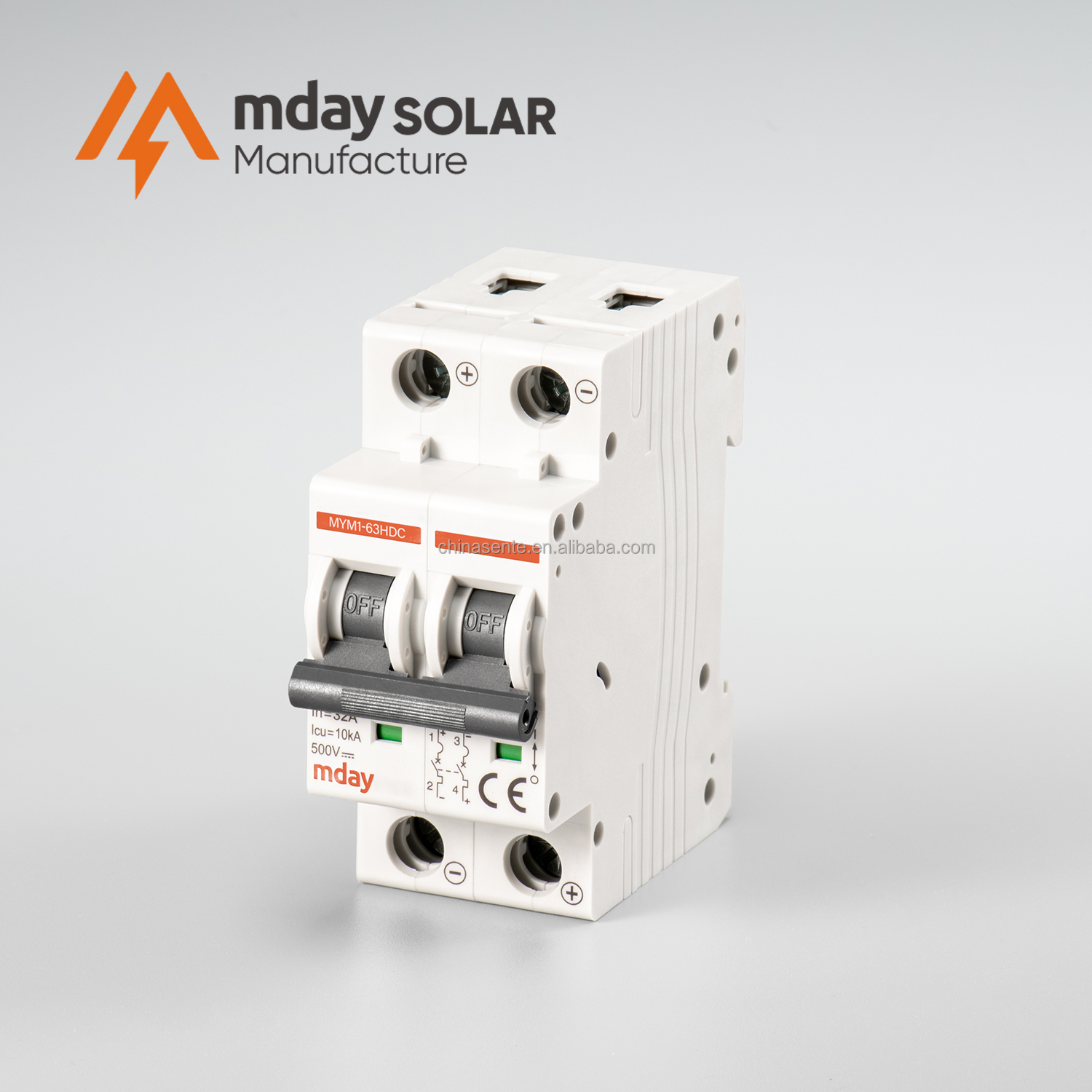
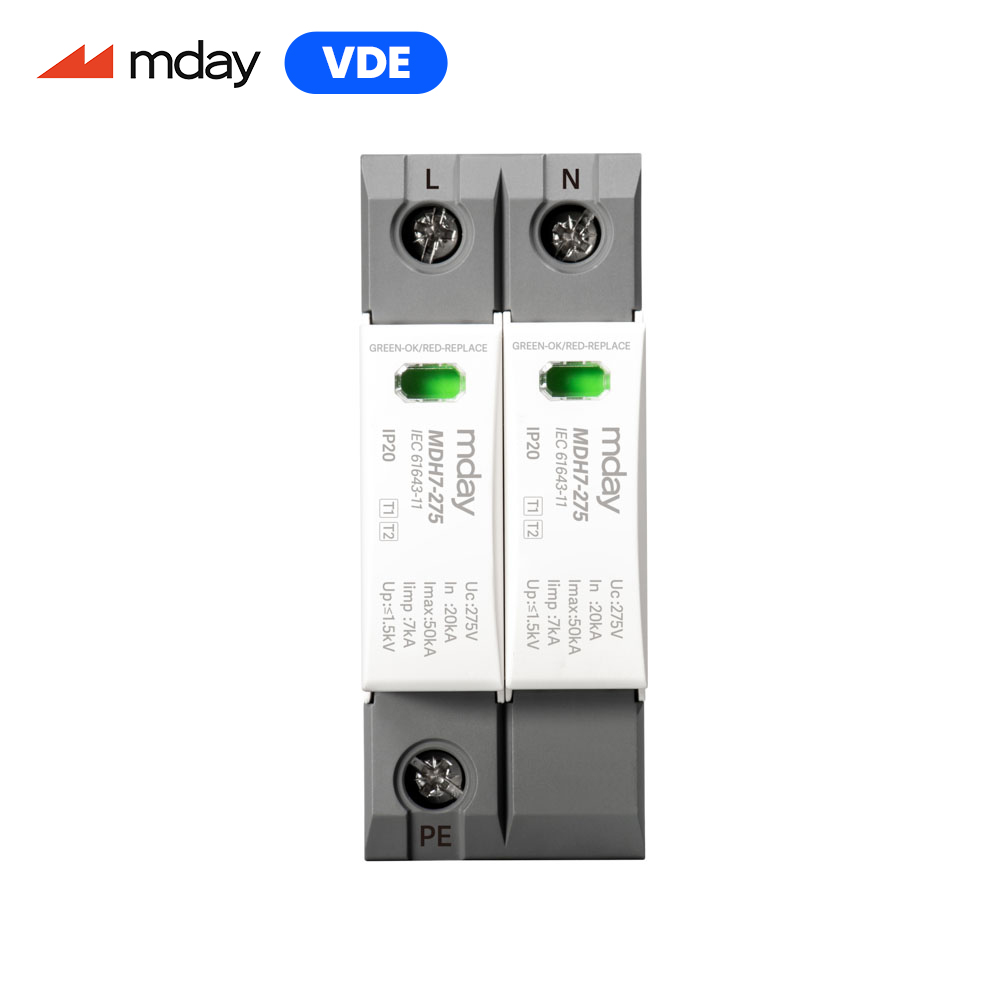
Luck (Zhejiang) New Energy Co., Ltd. Enterprise Advantage Architecture
As a leading OEM/ODM manufacturer headquartered in the Yueqing Economic Development Zone, Wenzhou, Zhejiang, China—the global epicenter of low-voltage electrical apparatus—Luck (Zhejiang) New Energy Co., Ltd. stands at the forefront of solar PV circuit protection. Backed by over 12 years of specialized engineering experience, we operate a TÜV Rheinland onsite-verified manufacturing facility equipped with automated injection molding workshops, SMT placement lines, and advanced electrical testing laboratories.
Third-Party Certified Safety
Our Surge Protective Devices carry authoritative VDE and CE certifications. Metal Oxide Varistor (MOV) blocks feature TÜV compliance, while 10x38mm solar fuse holders comply with UL 248-19 and IEC 60269-6 standards.
Rigorous In-House Quality Assurance
Equipped with 9 specialized testing instruments—including impulse current generators (8/20µs & 10/350µs waveforms), thermal breakdown test rigs, and contact resistance analyzers—every unit undergoes 100% full visual and electrical inspection.
Agile Customization & OEM Flexibility
With 7+ years of OEM service experience, we offer full OEM/ODM branding, tailored voltage thresholds ($U_c$ up to 1500V DC), custom housing colors, integrated remote signaling, and pre-wired IP65 combiner box solutions.
Technical Insight: Photovoltaic Surge Protection System Architecture
Solar photovoltaic plants represent expansive, exposed conductive arrays deployed in open environments, rendering them exceptionally vulnerable to atmospheric overvoltages, direct lightning discharges, and grid switching transients. Unlike standard Alternating Current (AC) electrical networks, Direct Current (DC) PV circuits possess unique physical characteristics—such as continuous non-zero crossing voltage and high system inductance—which present complex challenges for arc suppression and transient clamping.
| System Protection Point | Dominant Transient / Risk Factor | Recommended Protection Hardware | Key Standard Compliance |
|---|---|---|---|
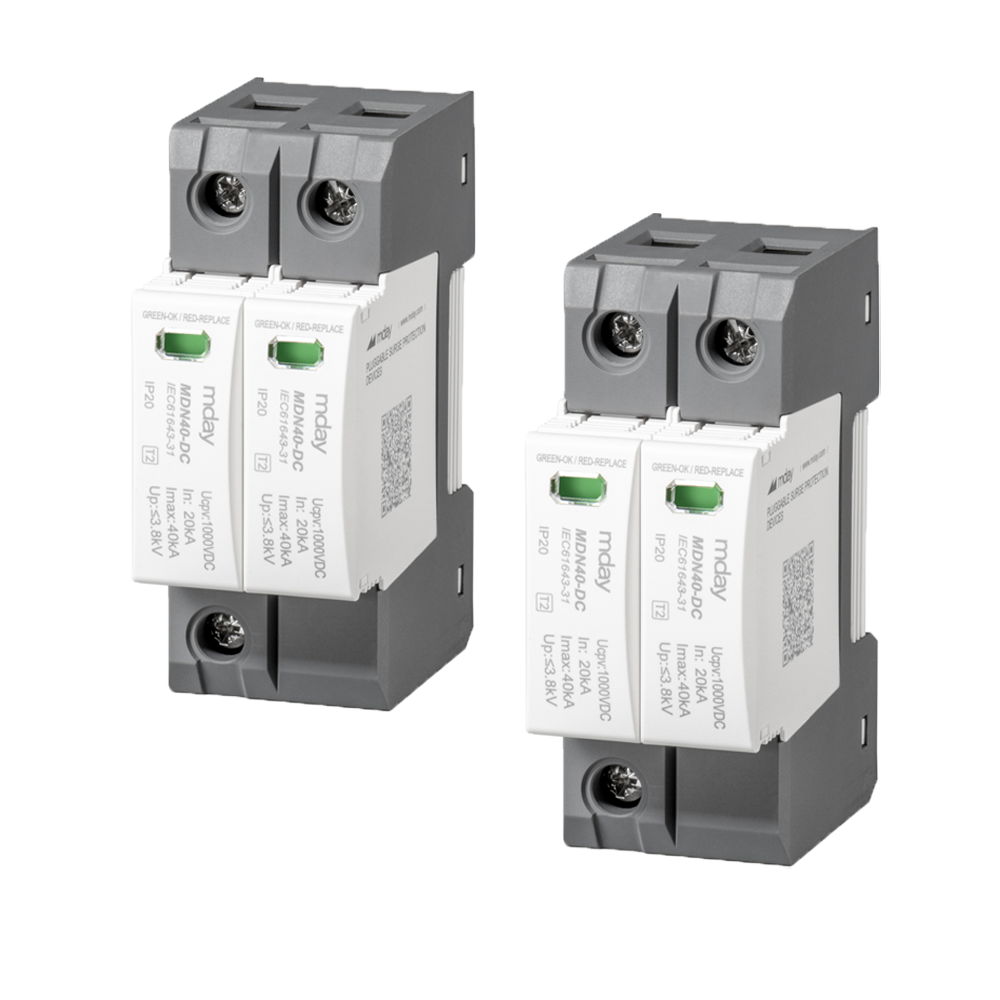
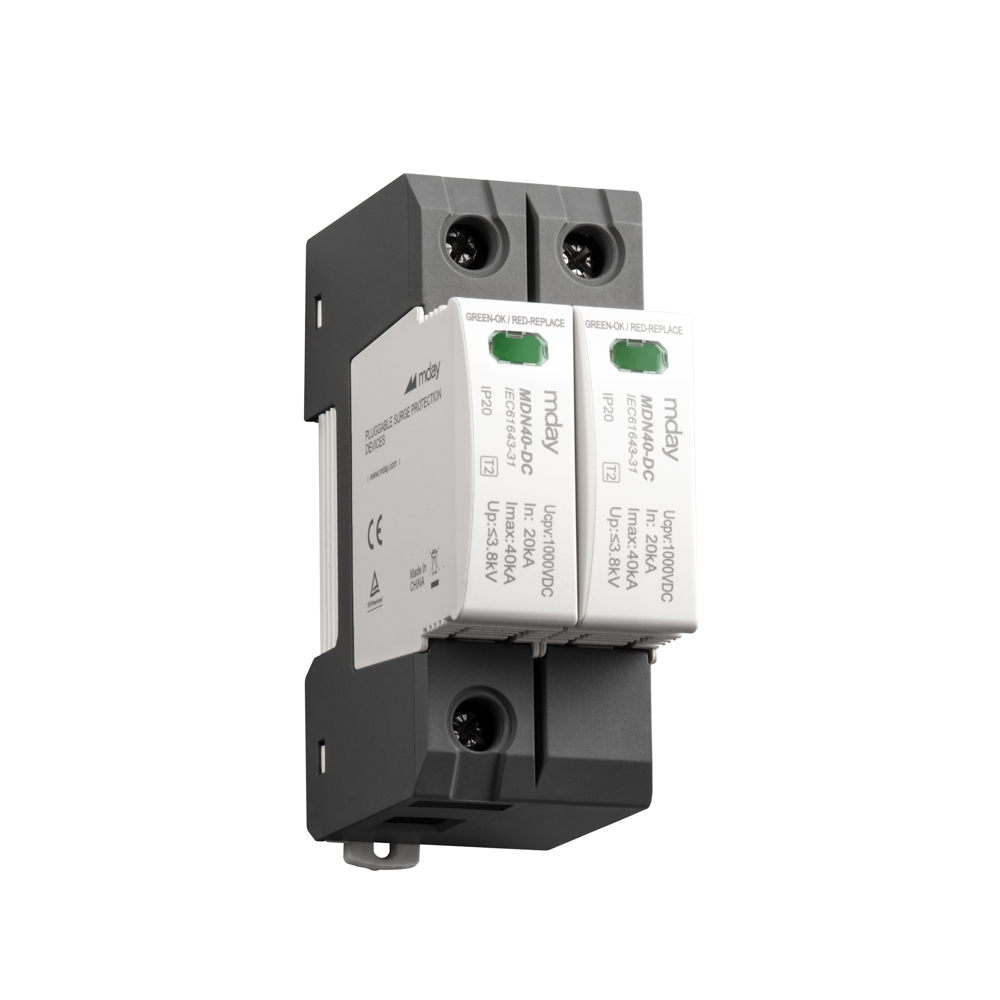
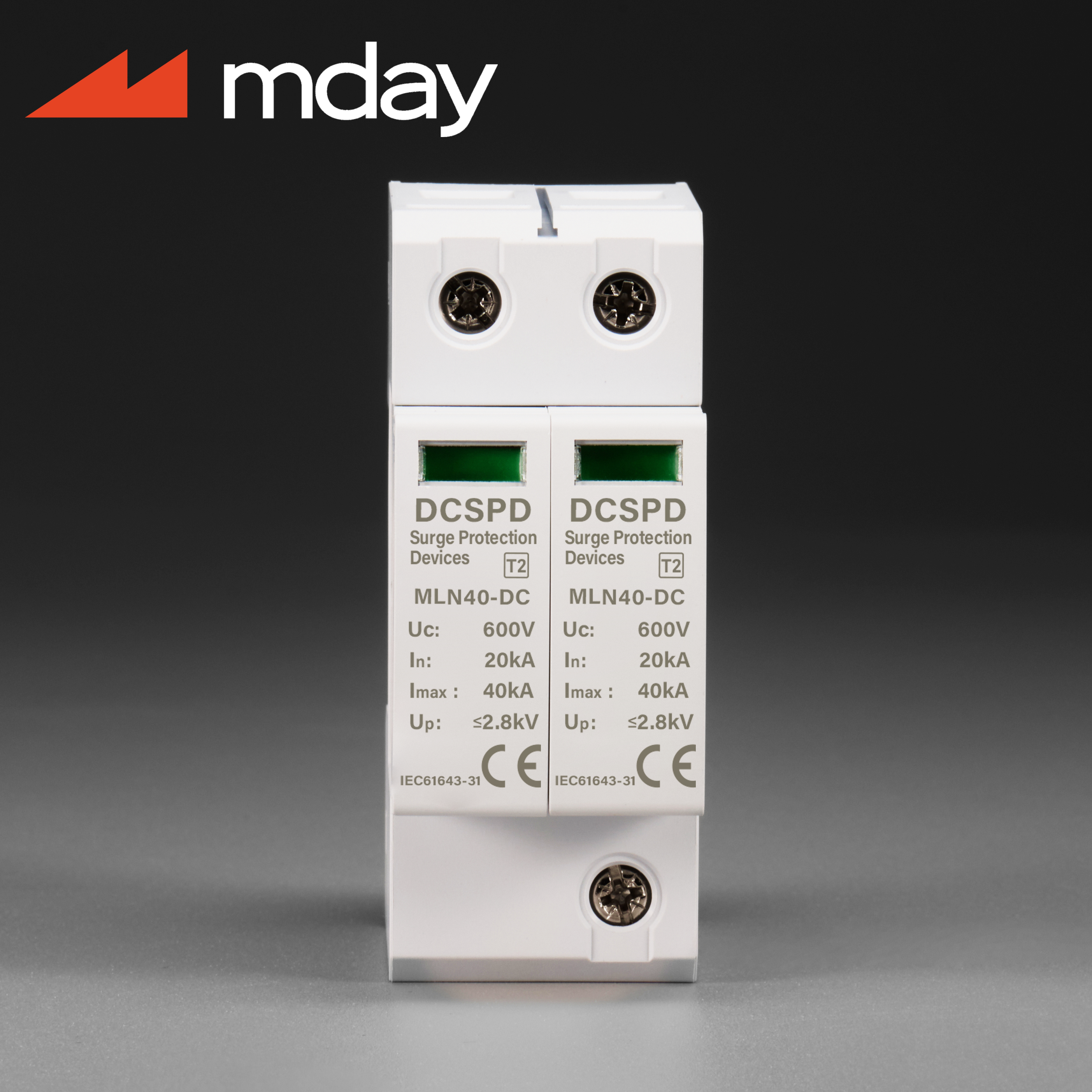
| PV String Level (DC Array) | Induced transient overvoltages, reverse string current | gPV 10x38mm Fuses + Type 2 DC SPD (MLN40-DC) | IEC 61643-31 / IEC 60269-6 / UL 248-19 |
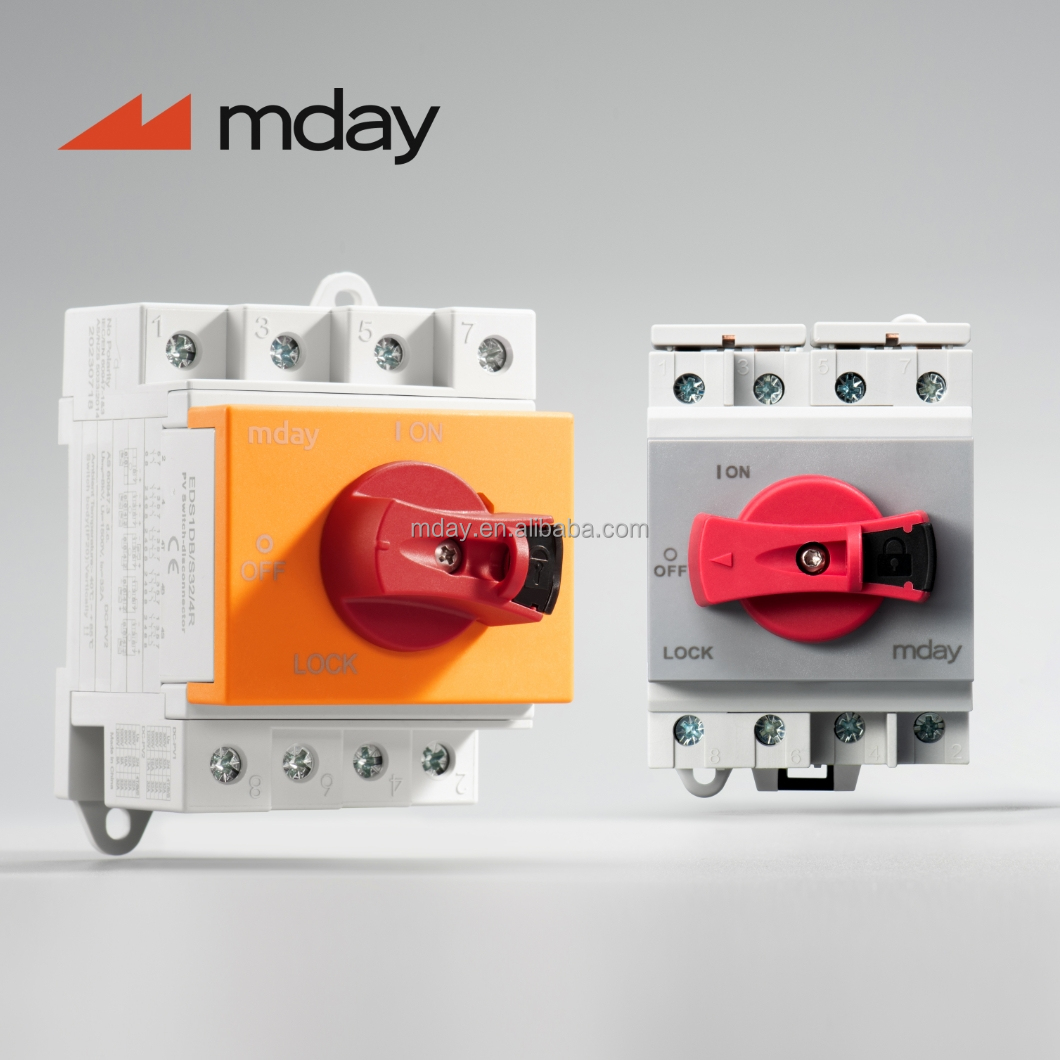
| DC Combiner / Inverter Input | High energy surge pulses, cumulative string short-circuits | 1000V/1500V DC MCB / MCCB + Heavy-Duty DC SPD | IEC 60947-2 / EN 50539-11 |
| AC Inverter Output / Grid Interface | Grid switching spikes, direct lightning surges ($I_{imp}$) | Type 1+2 / Type 2 AC SPD (MYH7 / MYN40 Series) | VDE / IEC 61643-11 |
| Energy Storage System (BESS) DC Bus | Bidirectional DC transients, high short-circuit energy | High breaking capacity DC MCCB + Square MOV Core | UL 1449 / IEC 60947-2 |
Transient Overvoltage Dynamics & Thermal Disconnector Safety: The core of a modern DC surge protector relies on high-energy Heavy-Duty Zinc Oxide Metal Oxide Varistors (MOVs). Under normal operating voltages ($U_c$), the MOV exhibits mega-ohm insulation resistance with negligible leakage current ($<20\,\mu\text{A}$). When a transient lightning wave strikes, the MOV transitions to a conducting state within nanoseconds ($<25\,\text{ns}$), clamping the surge voltage to a residual level ($U_p$) safe for sensitive inverter IGBT modules.
However, repeated surge impacts or continuous overvoltages cause MOV degradation, increasing leakage current and generating ohmic heating. Luck New Energy integrates a patented dual thermal disconnector mechanism. Upon reaching critical thermal thresholds ($>120^\circ\text{C}$), a high-temperature solder joint melts, mechanically detaching the degraded MOV via a pre-stressed spring and raising a high-visibility visual indicator flag (Green to Red) while tripping remote auxiliary contact terminals.
Future Procurement Trends in Solar Surge & Circuit Protection
As global energy transitions accelerate, solar procurement strategies are shifting from basic component sourcing to integrated, bankable protection architectures. Engineering, Procurement, and Construction (EPC) firms and global distributors must align with several key market developments:
1. Migration to 1500V DC Architecture
Utility-scale solar installations are rapidly standardizing on 1500V DC operating voltages to reduce balance-of-system (BOS) cable losses. This shift demands SPDs, fuse holders, and isolator switches with higher impulse withstand voltages ($U_{imp} \ge 8\text{kV}$), increased creepage distances, and specialized arc-chute geometry in DC circuit breakers.
2. Smart Telemetry & Condition Monitoring
Procurement teams are prioritizing SPDs and breakers integrated with IoT-ready remote status signaling contacts. Real-time telemetry allows automated SCADA systems to detect degraded protection modules before complete system outages occur, significantly reducing Operations & Maintenance (O&M) expenses.
3. Enhanced Fire Safety & Flame-Retardant Standards
With stricter international building and insurance requirements, component enclosures must feature self-extinguishing UL94-V0 thermoplastic housings, zero-halogen insulation, and high glow-wire ignition temperature (GWIT) ratings to mitigate electrical fire risks in harsh desert and tropical rooftop environments.
4. BESS Hybrid Storage Integration
The convergence of PV arrays with Battery Energy Storage Systems (BESS) creates extremely high short-circuit prospective currents ($I_{scpv} \ge 10\text{kA}$). Procurement trends favor bidirectional DC breakers and high-breaking-capacity gPV fuses engineered specifically to withstand repetitive cycling and rapid charge/discharge transient profiles.
Technology & Production Innovation at Luck New Energy
To meet rising global performance standards, Luck New Energy continuously upgrades its manufacturing infrastructure and materials science applications:
- Nanocrystalline ZnO Varistor Grain Structure: By utilizing high-purity zinc oxide formulations blended with bismuth and cobalt oxide additives, our 34mm square MOV blocks achieve superior energy absorption density ($>300\,\text{J/cm}^3$) and exceptionally tight clamping ratios ($U_p / U_c \le 2.5$).
- Ultrasonic Silver-Braze Terminal Welding: Automated assembly lines employ ultrasonic welding for MOV contact straps and copper terminal blades, eliminating joint cold-solder defects and guaranteeing contact resistance below $0.5\,\text{m}\Omega$.
- High-Breaking-Capacity Sand Quartz Matrix in gPV Fuses: Our 10x38mm solar fuse links utilize pure silver element ribbons embedded within high-purity chemically treated quartz sand, providing rapid fault extinction within milliseconds and breaking capacity up to 33kA at 1000V/1500V DC.
Frequently Asked Questions (FAQ) for Importers & B2B Buyers
How do I select the maximum continuous operating voltage ($U_{cpv}$) for a DC Surge Protection Device?
Why are standard AC circuit breakers and AC SPDs unsuitable for DC solar arrays?
What is the difference between Type 1+2 and Type 2 Surge Protective Devices in PV installations?
What certifications and test reports does Luck New Energy provide for international customs clearance?
What is the Minimum Order Quantity (MOQ) and production lead time for OEM orders?
What payment terms and trade terms are supported for overseas importers?
Partner with China's Premier PV Lightning Protection Manufacturer
Request our comprehensive 2025 product catalog, engineering datasheets, factory inspection reports, and wholesale OEM price lists. Our technical sales team responds within 12 hours.
